
Part 7 of The TIER Files, a series that follows Alberta’s industrial carbon money from the smokestack to wherever it actually ends up.
Everything here comes from audited financial statements and public documents. Sources, with page numbers, are at the bottom.
Every set of audited financial statements has a note where the related parties live, and if you read enough years of them in a row, the notes stop being disclosures and start being a story. This instalment is that story, told across fifteen years of one recurring note in the statements of CCEMC and then ERA, and I want to say up front that every number and every quoted phrase below is the organization’s own, signed off by its auditors, published on its own website. The work is reading the notes in order.
The years with no staff
Here is a thing I did not expect to learn when I started this series: for roughly its first eight years, the corporation distributing Alberta’s industrial carbon compliance money had no staff of its own. The entire program management function, the people evaluating projects and running competitions and writing the cheques, was delivered by external contractors with a reporting line straight to the board. The notes describe them, year after year, as contract management “who report directly to the Board.”
The fees, as disclosed: $2.65 million in fiscal 2010, then $3.35 million, then $4.31 million, then $7.07 million in fiscal 2013 as first reported, then $6.84 million, then a gap (we’ll get to the gap, it has its own instalment), then $4.31 million and $4.38 million. Add it up and the outsourced-management era cost roughly $31.7 million, paid to board-reporting contractors, during the same years the corporation was approving hundreds of millions in project funding.
You can defend this design, and people did. A new fund wants to move fast, hiring public-sector staff is slow, and buying an experienced management team off the shelf gets money flowing in year one instead of year three. Fine. But hold the structure in your head for a second: a board, and reporting directly to that board, private companies being paid millions a year to be the organization. There is no layer in that arrangement where an employee with a duty to the institution sits between the governors and the vendors, because the vendors are the institution.
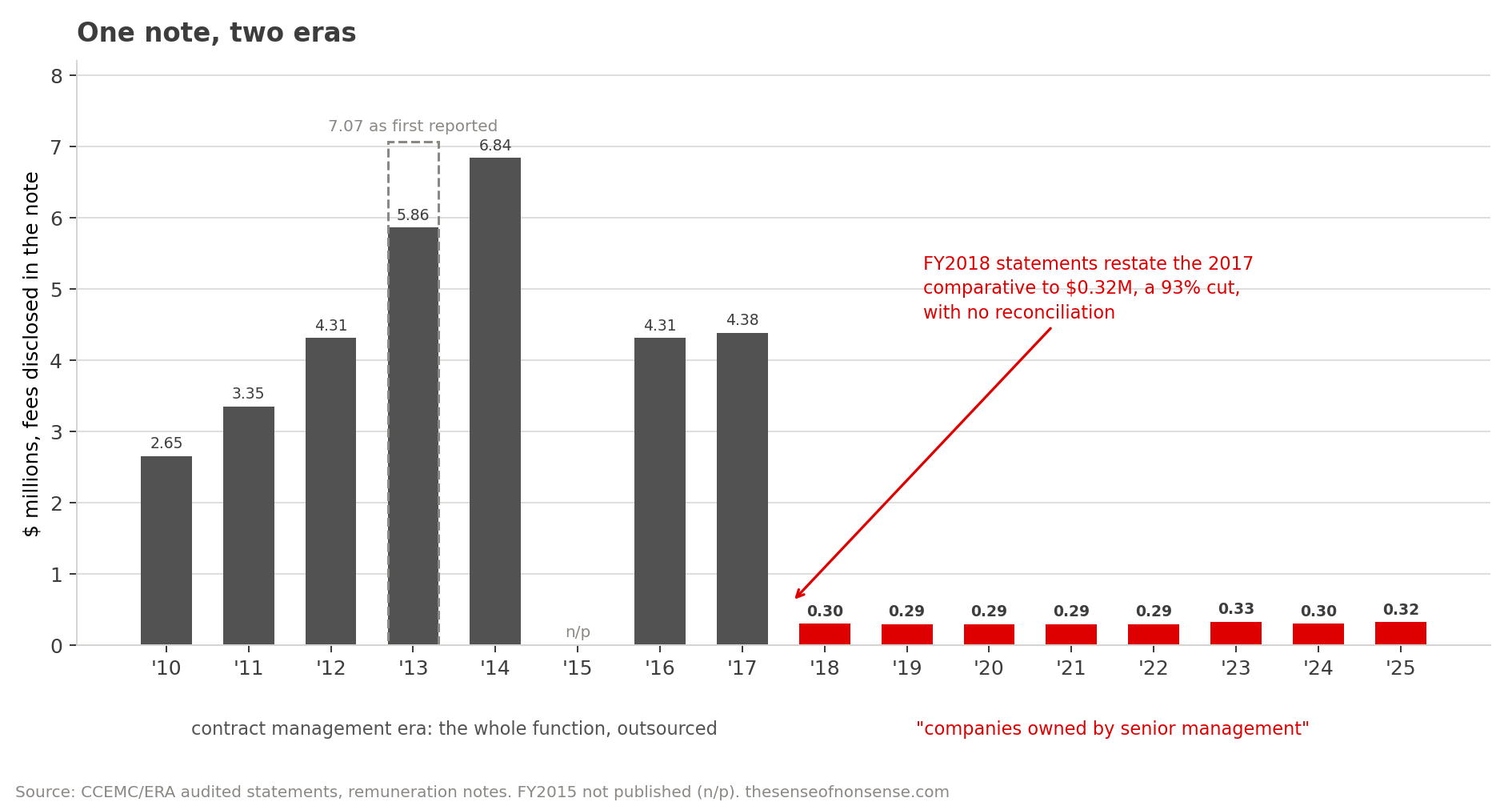
One recurring note, two eras, and a restatement in the middle that nobody explained.
The restatement nobody explained
Around fiscal 2018, ERA hired actual employees, and the note changed. Not gradually. The fiscal 2017 statements disclose contract management fees of $4,383,880. The fiscal 2018 statements, published a year later, restate that same 2017 comparative as $323,085.
That is a 93 per cent reduction in an audited comparative figure, between two sets of audited statements, with no reconciliation I can find in either document. The plausible explanation is definitional: staff came in-house, and “contract management” was quietly narrowed from meaning the whole outsourced function to meaning only the residual arrangement that survived the transition. But plausible is my word, and I’d rather have theirs. The same problem shows up earlier in the series too, where the 2013 statements report $7,065,379 and the 2014 statements restate it to $5,858,585, a $1.2 million difference between two audited documents that simply coexist.
When an audited number shrinks 93 per cent between one year’s statements and the next, somebody, somewhere, wrote a memo about it. The public just never gets the memo.
The public statements do not contain that reconciliation. If ERA publishes one, this page will be corrected or expanded.
The arrangement that never ended
Here is the part that turns a historical curiosity into a current one. That residual arrangement, the one worth $323,085 in restated 2017, is still running.
Every single year from fiscal 2017 through fiscal 2025, the note discloses fees to the same category of counterparty: $305,130, then $287,595, then $294,525, then $290,220, then $287,595, then $333,455, then $304,999, then $321,613. Nine consecutive years, remarkably stable, totalling about $2.75 million.
And in fiscal 2023, after more than a decade, the wording of the note finally said what the arrangement was. Through fiscal 2022, the disclosure read, and I am quoting the audited statements: “remuneration to contract management who report directly to the board.” From fiscal 2023 onward it reads: “remuneration to companies owned by senior management who report directly to the board.”
Same line. Same arrangement. Same approximate amount. The only thing that changed is that the sentence stopped being polite about it. The people running Alberta’s flagship clean technology agency own companies, and the agency pays those companies, roughly $300,000 a year, every year, and has for as long as the disclosure lets us see.
Through fiscal 2022 they were “contract management.” From fiscal 2023 they are “companies owned by senior management.” The arrangement stayed. The sentence changed.
The blanks in the note
To be precise about what the record supports, because precision is the whole game here: the notes leave the companies unnamed. They leave unnamed which senior managers own them. They leave undescribed what the fees purchase. They leave unstated whether the arrangements were competitively procured or how the board satisfies itself annually that paying its own executives’ companies is the best available deal. All of that may have perfectly boring answers. Corporate registries exist, and a future instalment of this series is being built from them, along with the rest of the map of who owns what and who sat where across seventeen years of this ecosystem.
And the fair paragraph, as always, because it is earned: this is disclosed. Every year, in an audited statement, reviewed by a Big Four firm, published voluntarily in a PDF anyone can download. The arrangement appears annually in audited language that has grown more exact over time. The people involved may well provide services at below-market rates out of genuine commitment to the mandate. The public record is silent on that point either way.
The silence is the actual finding. A public agency distributing a compliance levy has paid companies owned by its own senior management, continuously, for at least nine years, and the entire public accounting of that arrangement is one sentence per year and a number. The bar for spending other people’s mandatory payments is supposed to sit a little higher than “technically disclosed.”
The arrangement is disclosed in a sentence and a number. The public file still withholds the company names, the managers, and what the fees buy.
Next: Part 8, fixing the machine. The network map that sits beside this note is Part 6. A review of the TIER Regulation had been due by the end of 2026; Order in Council 369/2025 moved that deadline to 31 December 2030.
If I have misread a line item, the documents are linked below; show me and I will correct it. And if you can explain the 2018 restatement, the comment section and the inbox are open.
Sources
- CCEMC audited financial statements, program management and remuneration notes: AR 2010 (notes 5-8); AR 2011 (pp. 32-35, fees of $2,654,100 and $3,347,013); AR 2012 (fees of $4,308,607); AR 2013 (pp. 42-45, fees of $7,065,379 as reported); AR 2014 (pp. 52-57, fees of $6,840,962 and the 2013 restatement to $5,858,585). All at eralberta.ca/about-era/annual-reports/.
- ERA Annual Report 2016-17, financial statements pp. 48-53 (fees of $4,383,880 for fiscal 2017; $4,310,124 for fiscal 2016).
- ERA Annual Report 2017-18, financial statements pp. 72-76 (fees of $305,130; the fiscal 2017 comparative restated to $323,085).
- ERA financial statements FY2019 through FY2025, remuneration notes (the nine-year series through $321,613 in FY2025; the FY2025 note at p. 12 of the standalone statements).
- Note wording change: ERA FS FY2022 (“remuneration to contract management who report directly to the board”) versus ERA FS FY2023 onward (“remuneration to companies owned by senior management who report directly to the board”).
- The 2015 annual report, which contains no financial statements (the gap year in every series above).
- Order in Council 369/2025, s. 23 (TIER Regulation review deadline moved from 31 December 2026 to 31 December 2030). King’s Printer