
Part 3 of The TIER Files, a series that follows Alberta’s industrial carbon money from the smokestack to wherever it actually ends up.
Everything here comes from audited financial statements and public documents. Sources, with page numbers, are at the bottom.
If you have ever laddered GICs for a retired parent, the following will feel warmly familiar, right up until you remember whose money it is.
As of May 31, 2025, Emissions Reduction Alberta, the arm’s-length agency that receives the largest share of Alberta’s industrial carbon compliance grants, held $40 million in short-term GICs at Scotiabank and Canadian Western Bank earning between 4.54 and 5.49 per cent, and another $190 million in long-term GICs at Scotiabank and ATB, maturing between November 2026 and April 2027, earning between 3.75 and 4.14 per cent. Add the $309.5 million sitting in plain cash and you get $539.5 million, parked.
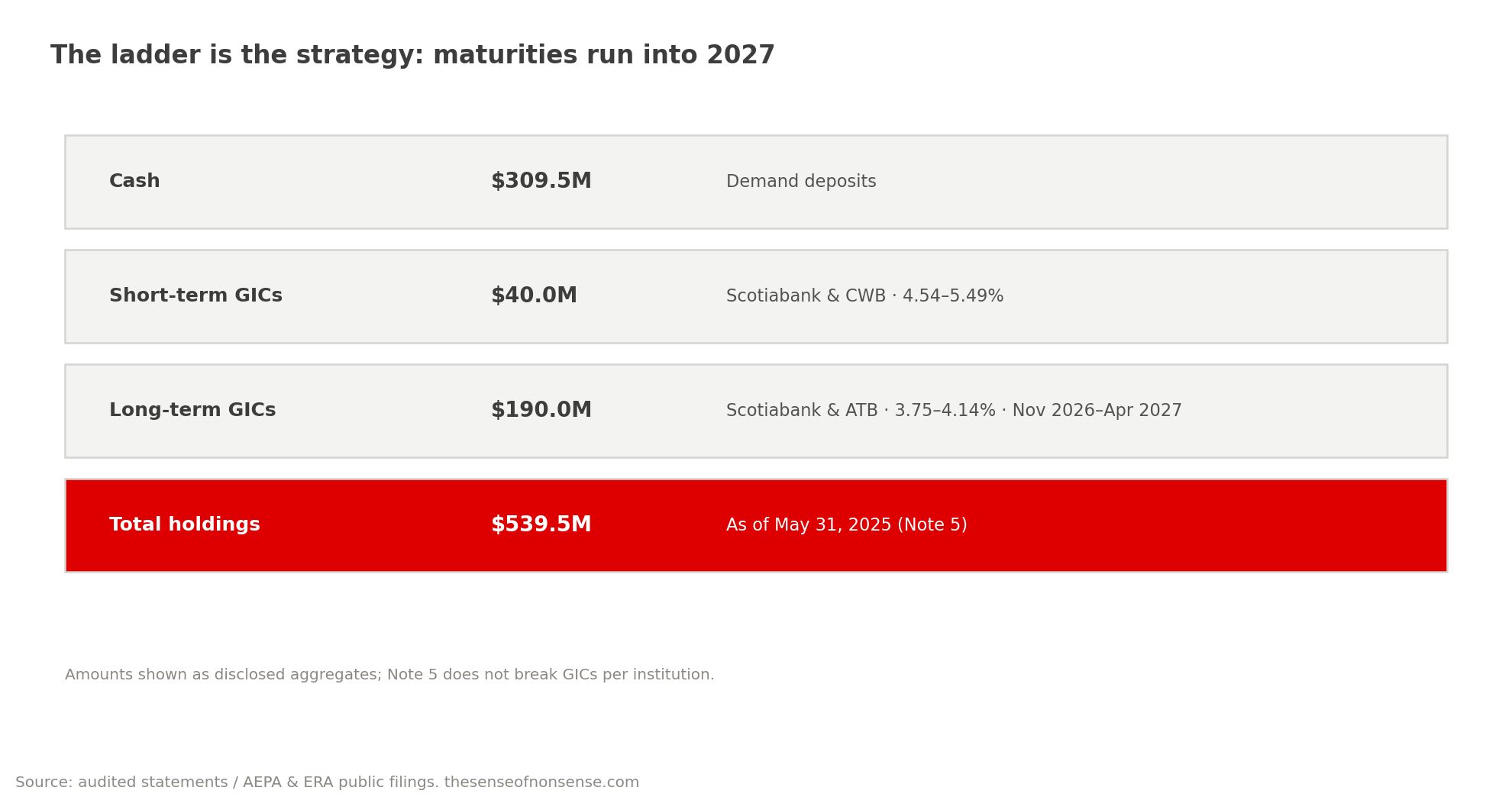
The ladder as disclosed, reformatted from Note 5. It reads like a retirement statement because structurally it is one. (Institution totals only; Note 5 does not break the GIC amounts per bank.)
That’s from Note 5 of ERA’s own audited statements, and honestly it’s a perfectly competent piece of treasury management. Sensible institutions, decent rates, staggered maturities. If a client brought me this portfolio I’d nod approvingly. The problem is that a client didn’t bring me this portfolio. This is the accumulated industrial carbon levy of the province of Alberta, collected from emitters at up to $95 a tonne on the promise that it would fund emissions reduction, currently earning bank interest with maturity dates two years out.
An agency does not ladder money into 2027 that it intends to spend soon. The portfolio is the strategy, written down.
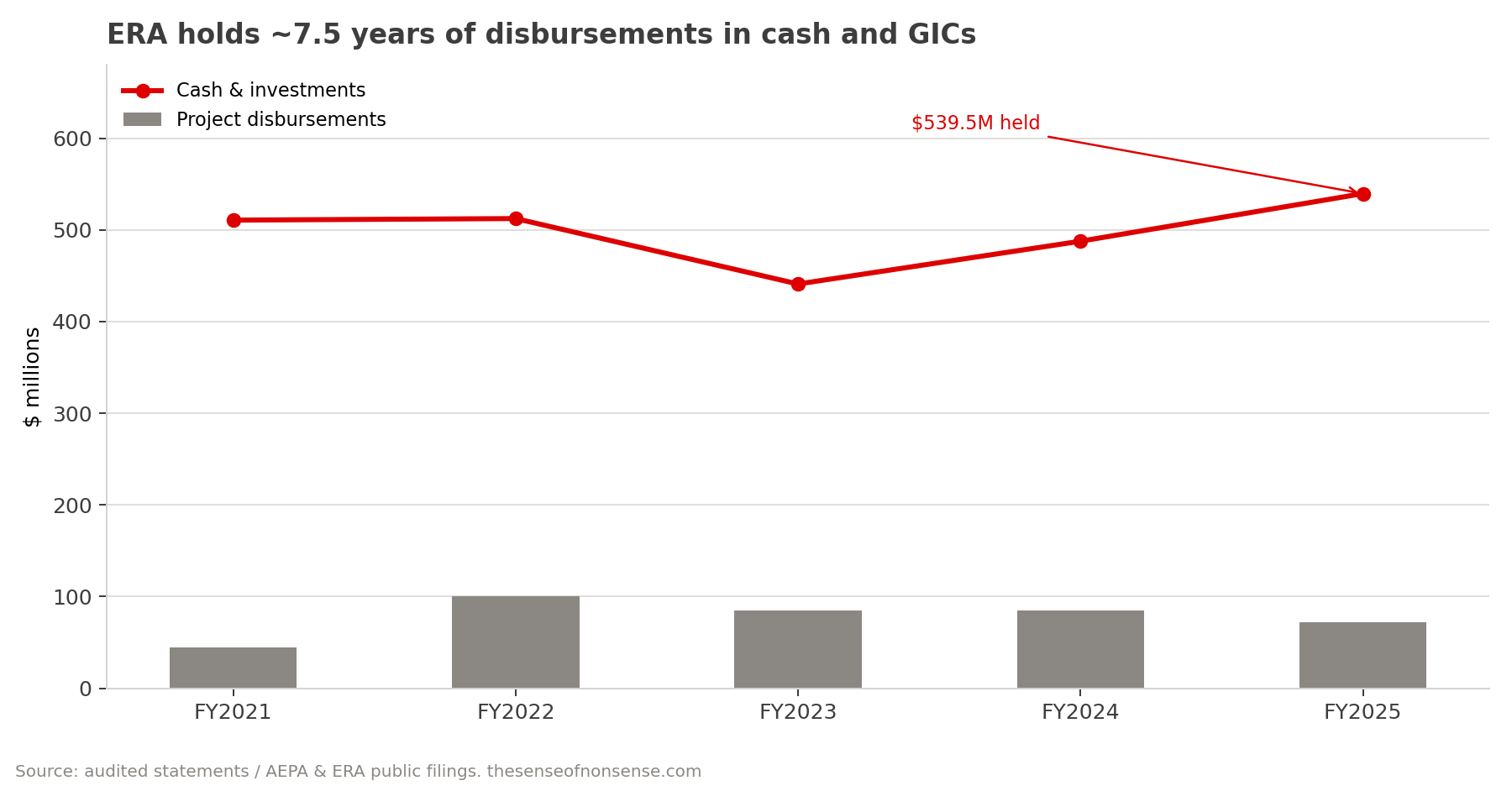
Roughly seven and a half years of disbursements, held.
The arithmetic of sitting still
Some context for the pile. ERA paid out $71.7 million to projects last year. So the agency is holding roughly seven and a half years of disbursements at its current pace, and the pace has been slowing, not quickening ($100.7 million in fiscal 2022, then $84.4, then $84.3, then $71.7).
Meanwhile the interest accumulates the way interest does. $4.6 million, then $5.3 million, then $19.2 million, then $29.7 million, then $25.6 million over the past five years, which comes to just over $84 million earned by holding the money. In fiscal 2024 the arrangement achieved something I want to make sure you don’t skim past: ERA’s interest income, at $29.7 million, exceeded half of its grant revenue for the year, which was $51.9 million. For every two dollars the government gave the agency to fund clean technology, the agency made another dollar by holding what it already had.
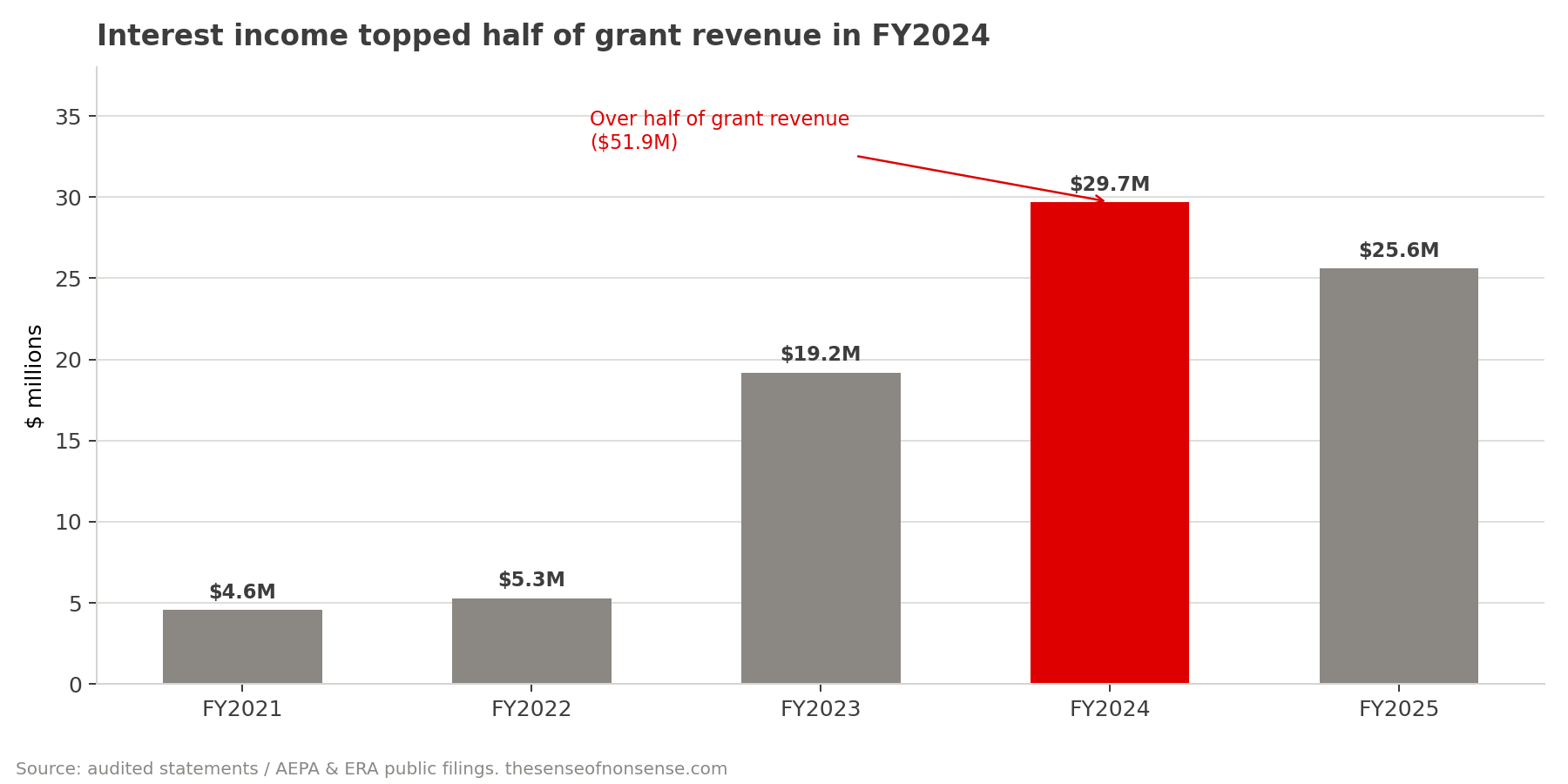
Just over $84 million in interest income over five years.
For every two dollars the government gave the agency to fund clean technology, the agency made another dollar by holding what it already had.
The float has history, too. This organization has been comfortable sitting on money since long before the current pile. Its own statements record that during fiscal 2016, in the churn of a provincial climate policy transition, the corporation received no grant money at all, not a dollar, and simply ran the year off its accumulated funds. An agency that can skip a year of revenue without breaking stride is an agency built around its reserve. That was a decade ago. The reserve has only grown since.
There are pension funds that would take that ratio. There are also, and I say this as someone who has sat on the applicant side of funding programs, a lot of project developers who spent that same year being told to wait.
The government has read Note 5 too
Here’s where it gets a little delicious. You might assume the province hadn’t noticed its climate agency turning into a fixed-income shop, but the paper trail says otherwise.
In August 2024, the annual allocation letter confirmed $50 million for ERA’s 2024-25 funding, and then reduced the actual cash transfer by $29.7 million, the amount of interest ERA had earned the year before, so what actually moved was $20.3 million. Two months later the province amended the grant agreement itself, the founding document of the whole relationship, to make interest clawbacks a permanent feature going forward.
Governments do not write clauses like that for agencies they believe are moving money briskly. That amendment is the province stating, in contract language, that its clean technology fund earns enough passive income to partially fund itself, and that the treasury would like its float back, thank you. It’s the closest thing to an official confirmation of this series’ thesis that I expect to find, and it was disclosed in a note to the financial statements, which is to say, nowhere anyone was expected to look.
New deposits, new depositors
You’d think an agency sitting on half a billion dollars might see its inflows tightened all around. Instead, fiscal 2025 brought a new depositor, and it’s the federal government.
In June 2025, ERA’s Clean Fuel Regulations Compliance Fund was approved as a registered compliance mechanism under Ottawa’s fuel rules, and ERA’s own statements note it is the only approved fund of its kind in Alberta. By late August it had already received $188.2 million from federal fuel suppliers settling their 2024 compliance year, money the statements say is held in segregated accounts awaiting its own program design. So the organization holding seven years of provincial disbursements is now also holding a couple hundred million of federal compliance money, and if you’re keeping score, that’s two levels of government running carbon compliance cash through one arm’s-length balance sheet.
(Whether the environmental credit for all this money stays in Alberta is a different and worse question, and it gets its own instalment.)
The agreement that expired
One more thing the statements disclose, almost in passing: 96 per cent of ERA’s revenue comes from a single grant agreement with the province, and that agreement was set to expire on March 31, 2026.
That date has now passed. ERA is plainly still operating, still announcing challenges, still receiving allocations, so something was signed or extended. But as of this writing, nothing about the renewal terms has been published anywhere I can find, which means the single document governing the largest pool of climate money in the province, the one that was amended in 2024 to add the interest clawback, was renegotiated sometime this spring entirely out of view. The new terms will surface eventually in the fiscal 2026 statements, due this fall, and when they do I’ll read them, because the interesting question is whether the province tightened the leash or lengthened it.
Concession
The fair reading, and it deserves saying properly: an agency funding multi-year capital projects genuinely needs reserves, because a demonstration plant announced today draws its money over five years and you’d rather the money exist. Milestone-based payments are prudent. Earning interest on committed-but-undisbursed funds beats earning nothing, and every dollar of that $84 million is disclosed, audited, and now partially recaptured by the province.
But reserves are a means, and somewhere along the way this pile stopped being a means. A reserve sized at seven years of your own slowing disbursement pace, laddered out to 2027, growing faster than you can spend it, is not working capital. It’s an endowment, and endowments are what institutions build when preserving themselves has quietly become the mission. The province has effectively conceded the point in writing, first with the clawback clause and then by letting a third of the annual allocation get netted away against interest, which is a thing you only do to an agency whose problem is accumulation. Every dollar in that ladder is a tonne of carbon somebody paid to have addressed, and the honest description of the current arrangement is that Alberta’s industrial polluters are financing a bond portfolio with a climate mandate attached.
The levy payers of Alberta did not pay $95 a tonne to capitalize a bond fund, however competently run.
Next: the float, or what happens to money that gets announced and then never quite becomes a project.
If I have misread a line item, the documents are linked below; show me and I will correct it.
Sources
- Emissions Reduction Alberta, audited financial statements, year ended May 31, 2025 (KPMG): Statement of Financial Position (cash of $309.5M); Note 5 (short-term GICs of $40M at 4.54-5.49%, long-term GICs of $190M at 3.75-4.14% maturing November 2026 to April 2027; institutions named, amounts not broken out per bank); Note 3 (the August 26, 2024 allocation letter, the $29.7M interest reduction, and the October 11, 2024 grant agreement amendment); Note 11 (96% single-agreement revenue dependence and the March 31, 2026 expiry); Note 12 (CFR Compliance Fund registration June 5, 2025, and $188.2M received as of August 21, 2025). eralberta.ca
- ERA audited financial statements FY2021 through FY2025: interest income of $4.6M, $5.3M, $19.2M, $29.7M, $25.6M (five-year sum ~$84.4M); project expenses of $44.0M, $100.7M, $84.4M, $84.3M, $71.7M; FY2024 grant revenue of $51.9M; cash and investment balances of $510.6M, $512.3M, $440.9M, $487.6M, $539.5M.
- ERA financial statements / annual reports covering fiscal 2016 (no grant revenue that year; operations funded from accumulated reserves during the provincial climate-policy transition). eralberta.ca
- ERA program announcements and challenge notices through spring 2026 (continued operations following the March 31, 2026 grant-agreement expiry date). eralberta.ca