
Part 2 of The TIER Files, a series that follows Alberta’s industrial carbon money from the smokestack to wherever it actually ends up.
Everything here comes from audited financial statements and public budget documents. Sources, with page numbers, are at the bottom.
Last time we established that Alberta’s industrial carbon fund collected $2.64 billion in four years and sent most of it somewhere other than emissions reduction. This time I want to talk about the people who are supposed to make the whole machine trustworthy, because it turns out you can find them in the budget documents too (credit where due, the budget is transparent about it).
Every carbon market lives or dies on its referee (shout-out to Verra and the forest scandal). Somebody has to write the quantification protocols that decide what counts as a real tonne. Somebody has to approve offset projects, oversee the verifiers, run the registry, chase the facilities that misreport, and generally stand between a $95-per-tonne compliance obligation and everyone’s natural creativity about it. In Alberta that somebody is a branch of Environment and Protected Areas, and its budget line is “program 9.1, Regulatory and Operations,” under Emissions Management.
Here is what that line has looked like in the government’s own estimates and year-end statements, in thousands of dollars:
| Fiscal year | Voted budget | Actually spent |
|---|---|---|
| 2022-23 | 10,541 | 7,097 |
| 2023-24 | 10,541 | 7,468 |
| 2024-25 | 10,541 | 8,204 |
| 2025-26 | 10,541 | 10,541 (forecast) |
| 2026-27 | 10,541 | estimate year |
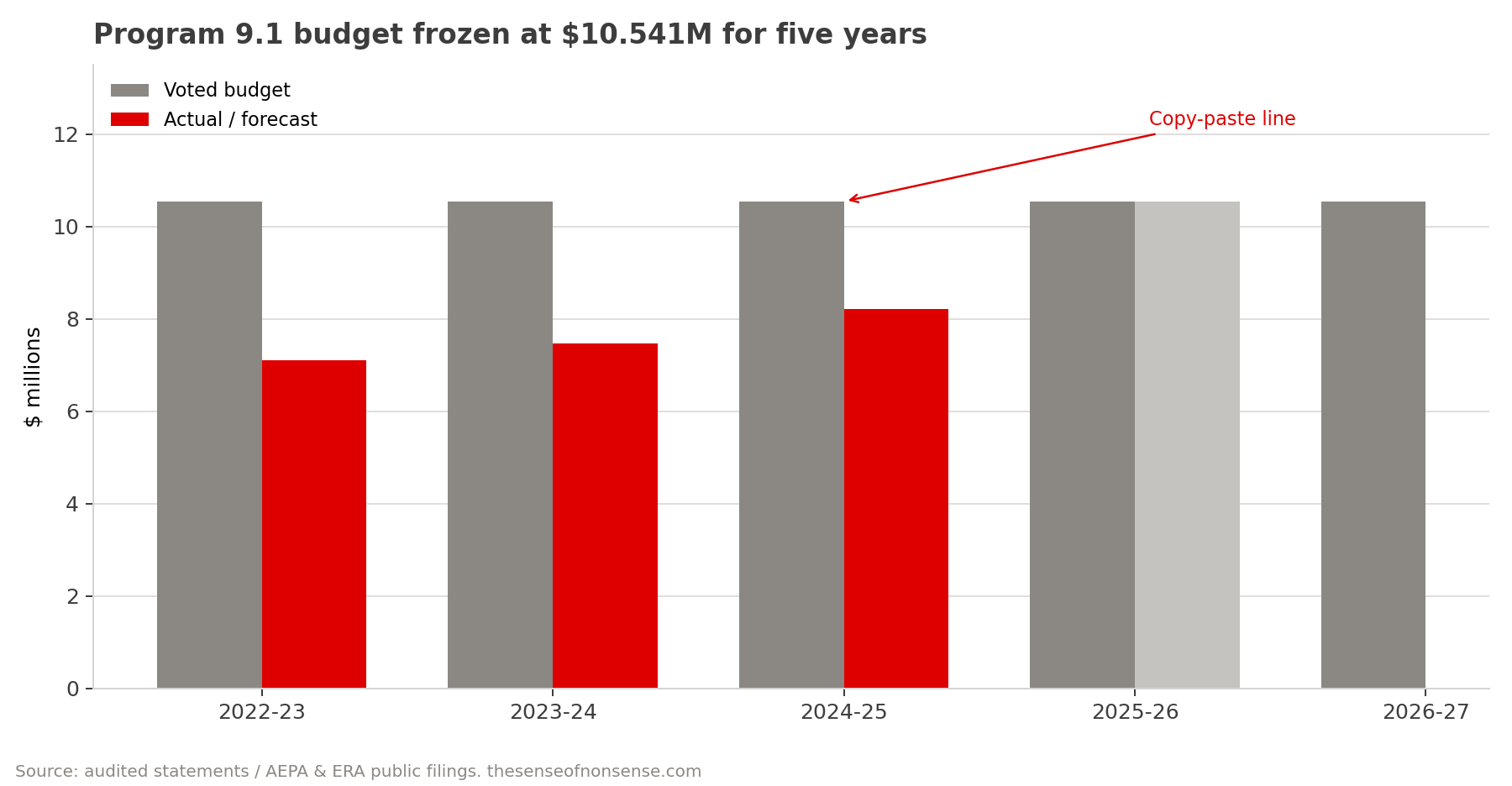
Five budgets, one number, underspent in every completed year.
You are reading that correctly. Five consecutive budgets, and the number is $10,541,000 in every one of them, not adjusted for inflation, not adjusted for the small matter of the carbon market halving in price and drowning in credits, not adjusted for anything. Somewhere in the budget process this line got set, and then it fossilized. (I have built enough budgets to know what a copy-paste looks like from the outside, and this is what a copy-paste looks like from the outside.)
The team refereeing a multi-billion-dollar compliance market runs on less than the interest income of the agency holding the grant money.
And the branch doesn’t even spend it. Actual spending came in under the vote by $3.4 million, then $3.1 million, then $2.3 million. The team refereeing a multi-billion-dollar compliance market has been running at roughly $7 to $8 million a year, underspending a budget that hasn’t moved since it was set.
For scale, some things that are bigger
It’s hard to feel a number like $8.2 million without something beside it, so here are a few comparisons, all from the same fiscal neighbourhood.
Emissions Reduction Alberta, the arm’s-length agency that receives the grants and writes the cheques (and which we will spend considerable time with later in this series), reported operating expenses of $11.4 million in its most recent year, and between $9.5 and $11.4 million in each of the past four. So the organization that distributes the money costs more to run, every single year, than the entire provincial operation that regulates the market the money comes from. The cheque-writer out-budgets the referee.
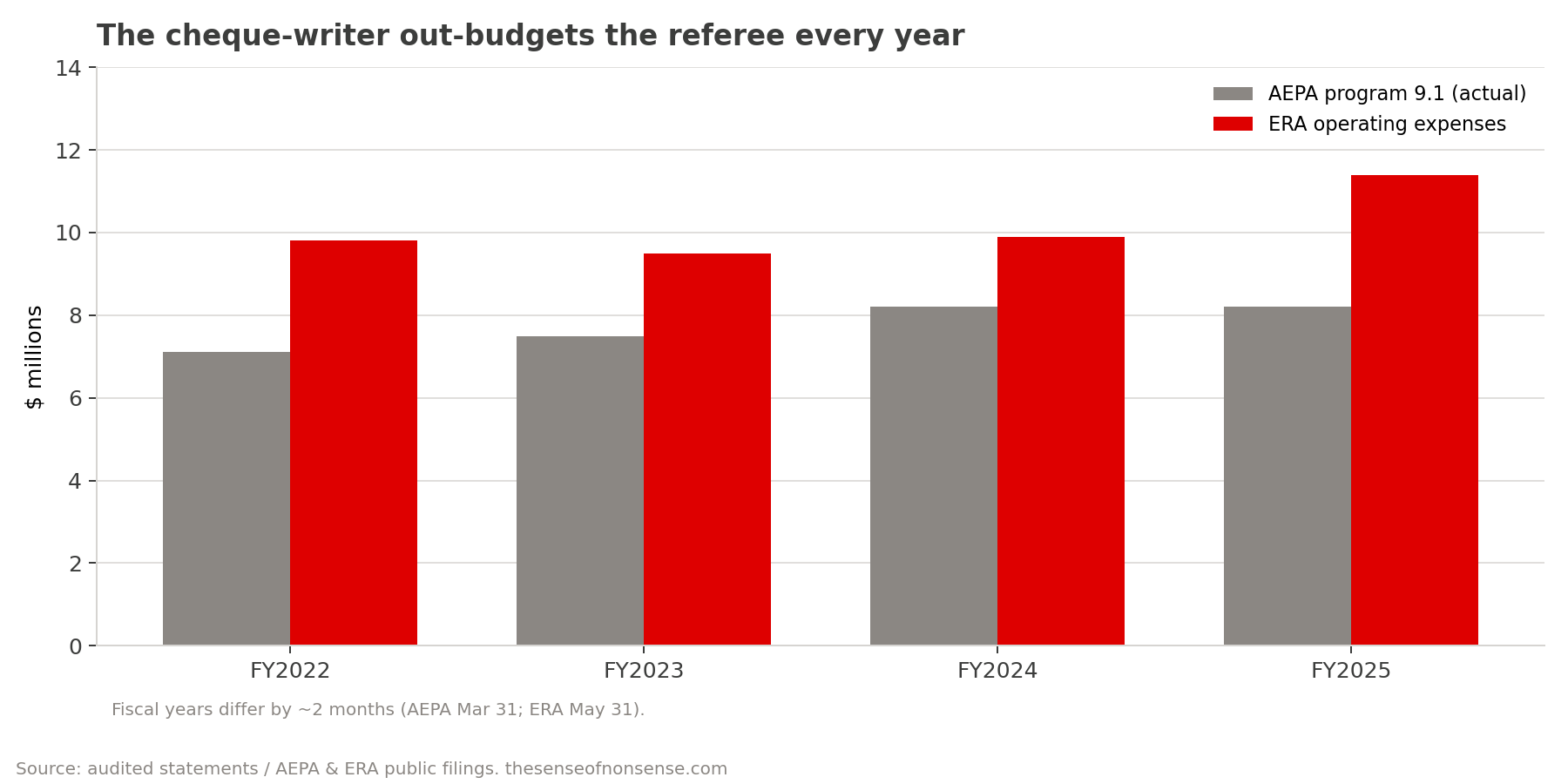
The agency distributing the money costs more to run than the operation regulating the market. Fiscal years differ by two months (AEPA March 31; ERA May 31).
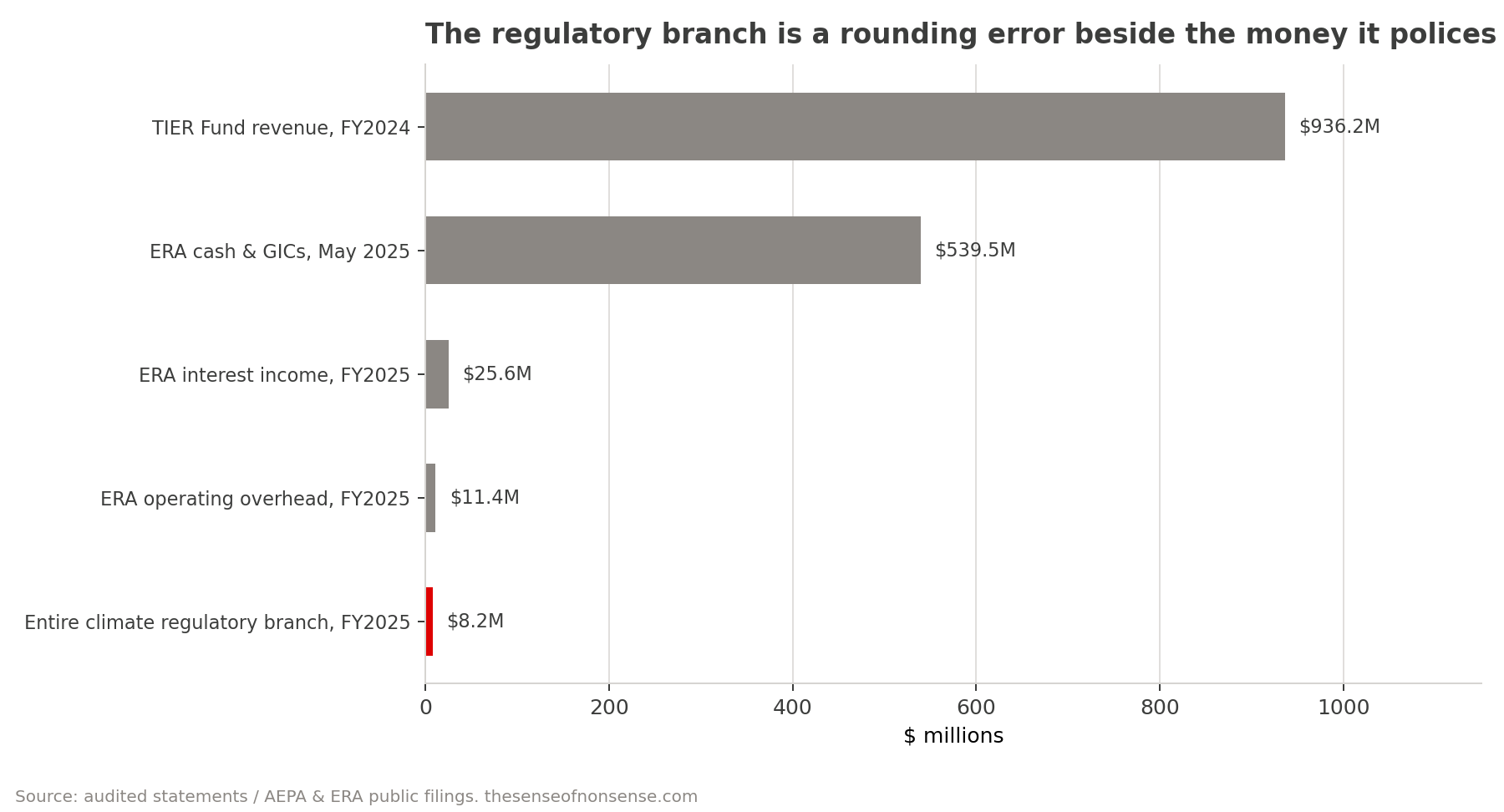
The referee, drawn to scale against the money it is responsible for.
The TIER Fund itself collected $936 million in fiscal 2024, which means the regulatory branch’s annual spend was worth about three days of the fund’s peak-year revenue.
And ERA earned $25.6 million in interest last year just from holding money in bank deposits and GICs, which is to say the interest on the undisbursed grant pile is roughly triple the budget of the people minding the entire system. (We’ll get to the GIC ladder next time. It deserves its own instalment, and it gets one.)
What happens when the referee is stretched
None of this would matter much if the job were going fine, so let’s check the record on that.
In December 2023 the Auditor General reported that a large emitter had underpaid the TIER Fund by $30 million after submitting inaccurate information used to set its facility-specific benchmark. Department staff initially believed they lacked the authority to collect it. Sit with that one for a second. The fund’s own regulator was short a sum nearly four times its annual operating spend, from a single facility, and the first institutional reaction was uncertainty about whether they were allowed to go get it. The Auditor General’s team concluded the department was wrong about its own powers: the Regulation allows the director to adjust errors “at any time.” The ministry subsequently reversed course and said it would pursue the outstanding amounts. You learn a lot about an organization from its reflexes.
The same December 2023 report’s recommendation summary showed Environment and Protected Areas carrying 19 outstanding auditor recommendations in total, eleven of them more than three years old. This is not a branch having one bad file. This is a department that has been quietly triaging its own mandate for years.
The protocol system tells a similar story in slower motion. Quantification protocols, the rulebooks that determine whether a tonne is real, have gone years between updates. Some have been withdrawn as unworkable. A few project types, carbon capture among them, are flagged so that nothing can even begin without written authorization from a director, which is a sensible control right up until you remember that a director is one person with one inbox, sitting inside an $8 million branch, and every proponent in the province is queued behind that inbox. Ask anyone who has taken an offset project through the system what the waiting feels like. (Ask them off the record, though. Everyone in this industry expects to apply again. Antagonizing the regulator is better done through political channels and proxies rather than forcing call screening.) That “one inbox” line is characterization of the director-authorization requirement, not a documented queue length; if a FOIP on approval statistics ever comes back clean, I will update it. Oh, by the way, where is the Minister of Red Tape Reduction exactly?
Meanwhile the workload keeps arriving. On December 3, 2025 the regulation was amended again by Orders in Council 369/2025 and 370/2025, creating an entirely new class of investment credits (plus reactivated credits). The same amendment moved the next statutory review from the end of 2026 to the end of 2030. Then the Canada-Alberta implementation agreement of May 15, 2026 kept the headline price at $95 for 2026, replacing the earlier $110 schedule, and committed Alberta to new price-floor rules by the end of 2026. The Standard for Direct Investment that is supposed to govern the new credits remained unpublished on the Alberta TIER page when I checked it. Somebody still has to write it.
And consider what the branch is actually refereeing now, because the market has not stood still while its budget did. When TIER launched in January 2020 the fund price was $30 a tonne and compliance meant credits, offsets, or cash. Six years later the price has tripled, the credit bank has ballooned into structural oversupply, and the instrument list has grown to five classes: emission performance credits, emission offsets, sequestration credits, and now investment credits and reactivated credits, the last two invented in December 2025 and still waiting on their governing standard. Every new instrument is a new integrity surface, a new thing that can be gamed, double-counted, or misquantified, and every one of them lands on the same desk with the same $10,541,000. All of that lands on program 9.1, which will have, per the current estimates, exactly $10,541,000 to do it with. Again.
Concession
To be fair about it, a small regulatory budget is not automatically a scandal, and I’d rather have a lean competent branch than a bloated incoherent one. Government departments underspend lines for boring reasons all the time, vacancies mostly, and a vacancy is sometimes just a vacancy. It is also true that some functions, like the registry, are contracted out and show up in other places.
But the pattern here is not lean-and-competent. The pattern is a budget line nobody has looked at in five years, attached to a function whose workload has exploded, exhibiting exactly the symptoms you’d expect: multi-million-dollar collection confusion, stale protocols, one-inbox chokepoints, and a market that traded down to a third of the compliance price partly because nobody adjusted supply. Alberta collects hundreds of millions of dollars a year on the premise that a tonne in this system means something. The entire apparatus for making tonnes mean something costs less than the interest income of the agency holding the grant money.
The disbursement side of this system has announcements, a board, a podcast, and an awards night. The integrity side has a frozen line item.
That’s not a funding decision anyone made on purpose, and that is precisely the indictment. Nobody decided the referee should be starved. Nobody had to. The disbursement side of this system has champions in every direction, because everyone loves announcing money. The integrity side has no constituency at all, so its budget line sat untouched through five budgets, a market collapse, a federal equivalency fight, and an auditor’s report that found the branch unsure of its own powers. Alberta has revealed its actual priorities in the most honest document a government produces, which is the estimates. You get more of what you budget for, and Alberta budgets for announcements.
Next: the climate fund that became a bank.
If I have misread a line item, the documents are linked below; show me and I will correct it.
Sources
- Department of Environment and Protected Areas, Statement of Lapse/Encumbrance, expense vote by program. Annual Report 2022-2023 p. 109 (program 9.1 voted $10,541K, actual $7,097K); Annual Report 2023-2024 p. 113 (voted $10,541K, actual $7,468K); Annual Report 2024-2025 p. 113 (voted $10,541K, actual $8,204K). open.alberta.ca
- Budget 2026, 2026-27 Government Estimates, Environment and Protected Areas, Expense Vote by Program (program 9.1 at $10,541K for the 2025-26 budget, 2025-26 forecast, and 2026-27 estimate).
- Emissions Reduction Alberta, audited financial statements FY2022 through FY2025 (operating expenses of $9.8M, $9.5M, $9.9M, and $11.4M; interest income of $25.6M in FY2025). eralberta.ca
- Auditor General of Alberta, Report of the Auditor General - December 2023, released December 14, 2023: $30 million TIER Fund underpayment; department initially concluding it lacked collection authority; auditor finding the Regulation allows the director to adjust errors “at any time”; department subsequently agreeing to pursue amounts (pp. 79-84 / key findings). Recommendation summary table: Environment and Protected Areas, 19 outstanding recommendations, 11 older than three years and 8 younger than three years. Primary PDF: oag.ab.ca. Contemporary reporting: CBC News, December 15, 2023.
- TIER Fund audited financial statements, Environment and Protected Areas Annual Report 2024-2025, p. 56 (FY2024 revenue of $936.2M); Ministerial Order 13/2025 per Note 8, p. 72.
- Orders in Council 369/2025 and 370/2025, December 3, 2025 (investment credits, reactivated credits, related amendments, and review deadline moved to December 31, 2030). Alberta.ca TIER overview (Standard for Direct Investment expected early 2026).
- Canada-Alberta, Implementation Agreement for the Memorandum of Understanding of November 27, 2025, May 15, 2026 (2026 headline price of $95; price-floor regulation intended by December 31, 2026). Government of Canada