
Part 4 of The TIER Files, a series that follows Alberta’s industrial carbon money from the smokestack to wherever it actually ends up.
Everything here comes from audited financial statements and public documents. Sources, with page numbers, are at the bottom.
When Emissions Reduction Alberta announces funding for a project, and there is usually a press release and a quote from a minister and a photograph of people in hard hats looking at something, what has actually happened is that a contribution agreement got signed, and the money itself hasn’t moved an inch. It stays right where it was, in the cash pile and GIC ladder we toured last time, and it will only ever leave in pieces, milestone by milestone, over the several years it takes to build whatever was announced. Which is reasonable enough on its own, since nobody sensible pays for a demonstration plant up front (I certainly wouldn’t).
But it means an announcement is really the opening of a float, and once you start reading the financial statements with that in mind, the whole program looks different, because the interesting question stops being how much was announced and becomes how much ever actually arrives.
So I went and added it up. Every statement of operations the corporation has published since it was created in 2009, first as the Climate Change and Emissions Management Corporation and then rebranded as ERA, contains a line called project expenses, which is the money that actually left the building and landed with a project that year. Sixteen years of those lines look like this, in millions:
| FY | Paid out | FY | Paid out |
|---|---|---|---|
| 2010 | 0 | 2018 | 34.1 |
| 2011 | 0.1 | 2019 | 33.6 |
| 2012 | 23.0 | 2020 | 38.2 |
| 2013 | 22.0 | 2021 | 44.0 |
| 2014 | 37.1 | 2022 | 100.7 |
| 2015 | not published* | 2023 | 84.4 |
| 2016 | 28.0 | 2024 | 84.3 |
| 2017 | 21.7 | 2025 | 71.7 |
*The 2015 annual report simply does not include the financial statements, which is its own small mystery (we will come back to the era those statements belong to, and it’s quite an era), so the lifetime total below allows a reasonable estimate for that year.
Add it up and you get about $650 million actually delivered to projects across the entire life of the program.
The number ERA publishes about itself, as of June 2026, is $1.17 billion committed toward 352 projects since 2009. Set those two figures side by side and sit with them a moment. This is a seventeen-year-old organization whose whole job is moving money to emissions reduction projects, and somewhere between 55 and 60 cents of every dollar it currently claims to have committed has ever made it out the door. The rest is either still working through the milestone pipeline, at $375 million of outstanding commitments as of last May, or it belongs to a category the press releases never revisit, which is the money that got announced and then quietly un-happened.
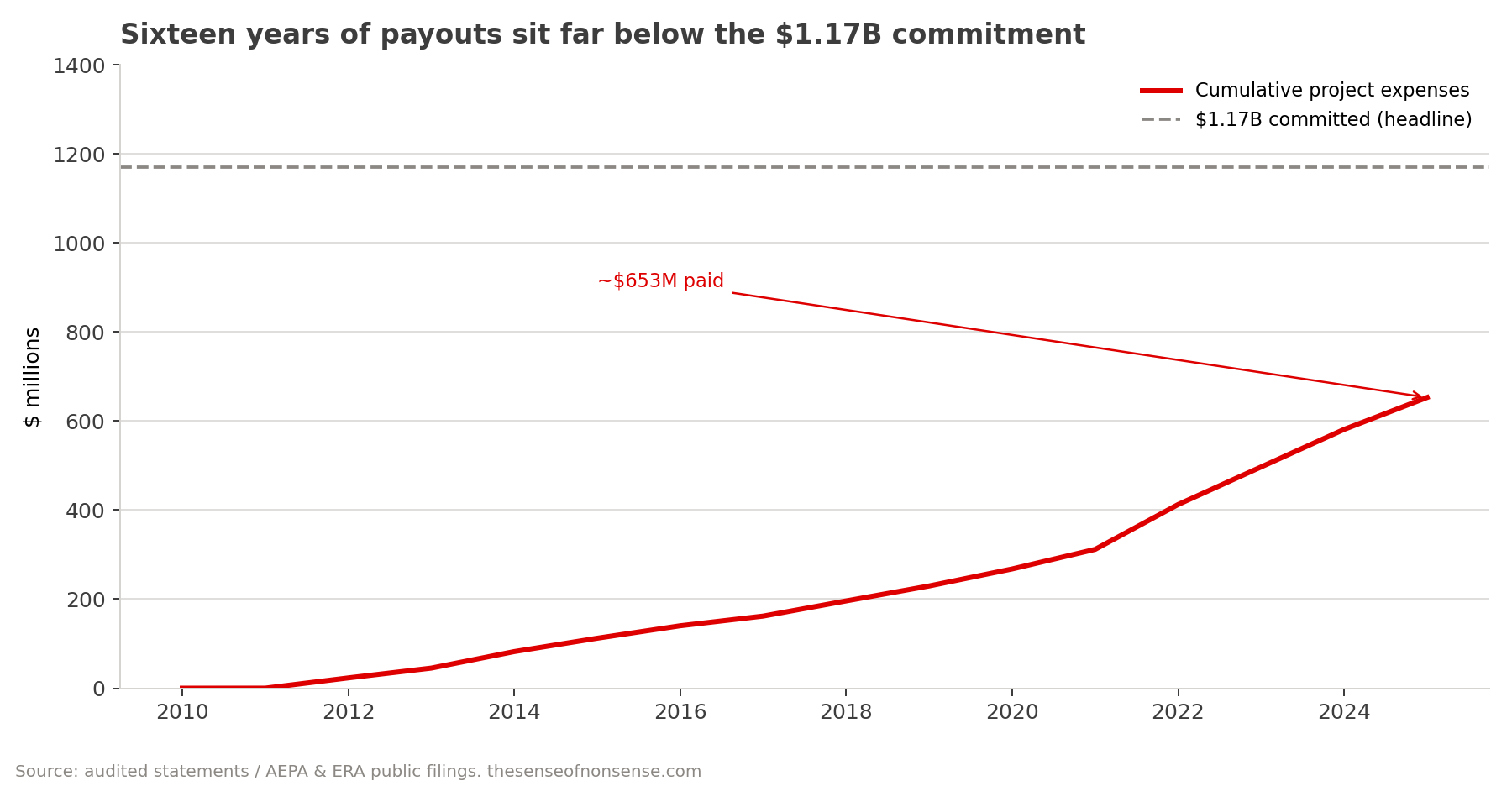
Sixteen years of disbursements against the current headline. FY2015 interpolated because the statements were never published.
The headline cleans itself
Here is the part I find genuinely impressive, in the way a good magic trick is impressive. Take the $650 million ever paid, add the $375 million still owing, and you land more or less exactly on ERA’s published lifetime figure. Which tells you the headline is a net number. Everything announced and later cancelled has been washed out of it, and the total is quietly self-cleaning: it can only ever look healthy, because its failures are deducted before you see it.
A hedge fund reporting returns this way would get a call from a regulator.
(That last one is analogy, not a legal claim. The architecture is the point.)
And that washed-out pile has gotten big. In the last four fiscal years alone, ERA cancelled or terminated $179 million worth of contribution agreements: $19.9 million, then $22.6 million, then $53.8 million, then $82.7 million, each year worse than the last. Every one of those dollars was, at some point, a funding announcement. Many came with the minister and the hard hats. When the projects died, the running total just absorbed the loss and moved on, and the gross amount this program has announced over its lifetime is accordingly larger than any figure ERA publishes today, by at least a couple hundred million dollars we can document from the recent years, and probably more from the earlier years where the disclosure gets thin. I am still reconstructing the full gross announced total from the press archive; treat that as a floor, not a ceiling.
In fiscal 2025 the machine hit a milestone of sorts, because the value of agreements cancelled or terminated that year, $82.7 million, exceeded everything ERA managed to actually pay out to projects, which was $71.7 million. Read that again, slowly.
In fiscal 2025, Alberta’s flagship clean technology funder un-funded more than it funded.
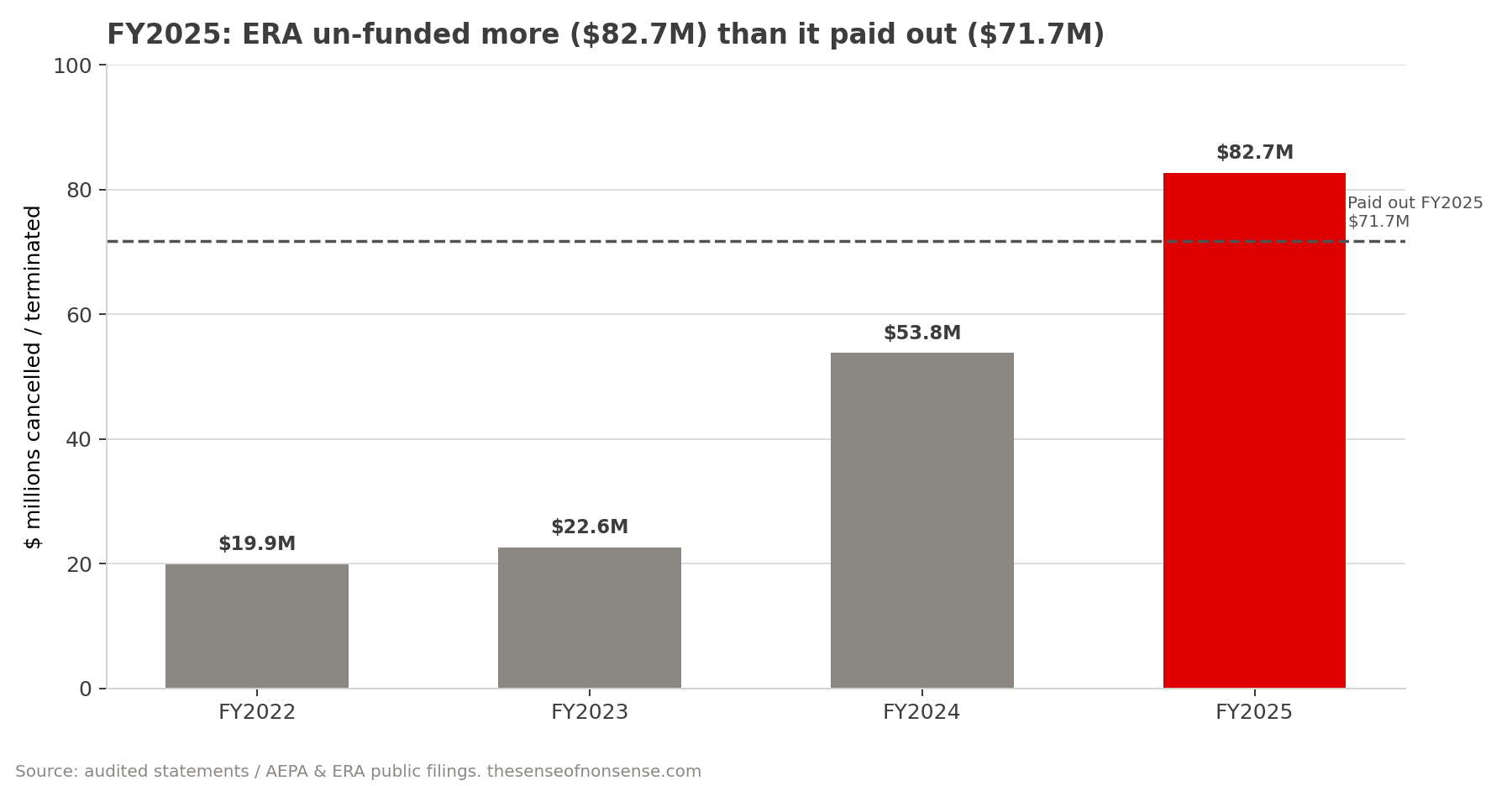
The un-funding curve crossed the funding line in fiscal 2025.
The statements record the wreckage in the flat tone auditors use for everything: five projects cancelled, nine terminated, four approved and never even initiated. And then, in the events after year-end, four more executed projects terminated or cancelled, two approved projects not proceeding, and six shifted to a status called On Hold, worth another $25.7 million. There is no press release for On Hold. (There is no podcast episode either, and they have a podcast.)
Where dead money goes
So what happens to a dollar committed to a project that will never exist? This is the question I actually set out to answer, and the statements are clear about it once you know where to look.
Nothing happens to it. That’s the answer. It never left ERA in the first place, so there is nothing to recover and nobody to chase. The commitment quietly comes off the books, the cash stays exactly where it has been all along, in the $539.5 million of cash and GICs from last instalment, and the dollar goes back into the pool to await its next announcement. ERA reported over $84 million in interest income across the past five years while holding money in exactly this way, and in fiscal 2024 its interest income was more than half its grant revenue, which is a strange ratio for a granting agency and a perfectly normal one for a bank.
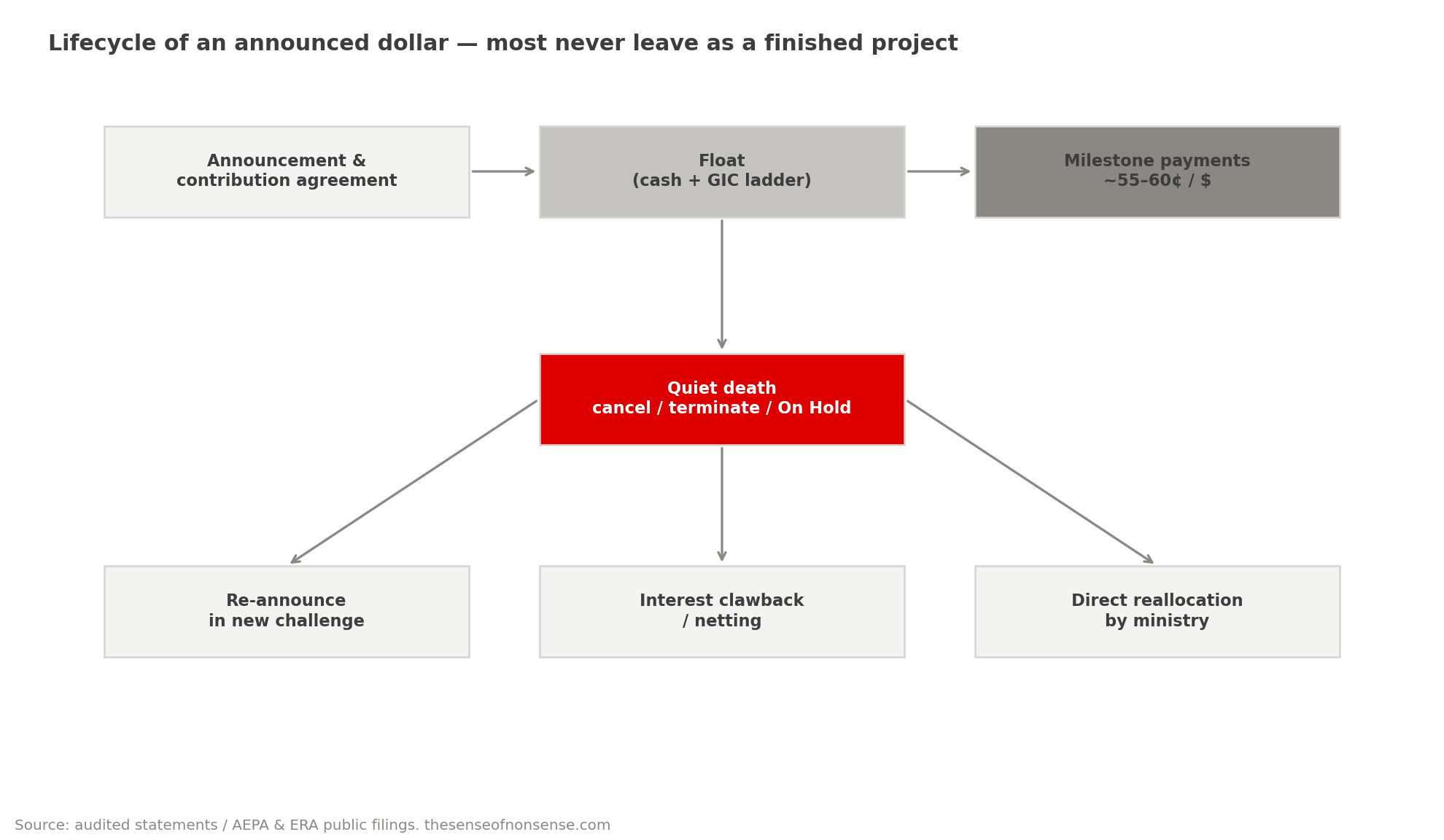
Sixteen years of audited statements, drawn as a flowchart.
A cancelled dollar can then do one of three documented things. Most often it gets recycled into a new funding challenge, where it will be announced again, and a dollar that gets announced twice does twice the work in a press release even if it never builds anything. Since October 2024 it can also be clawed back sideways, through the interest netting we covered in Part 3, which trimmed $29.7 million off a $50 million transfer. And occasionally the government just takes it back directly: in 2018 ERA had booked $20 million, of which $5 million was for developing a methane reduction program, and the following year a letter from the minister informed them the $5 million had been reallocated to another delivery entity, and ERA reversed the revenue. When the float gets big enough, other people start spending it.
The part where I’m fair about it
Now the honest concessions, because they’re real. Milestone-based payment is prudent, and the alternative, wiring full grants to unproven technology ventures on day one, would be genuinely stupid. Attrition is what innovation portfolios do, and a funder whose projects never failed would be a funder taking no risks worth taking. And none of this is hidden. Every number in this piece comes from audited statements that ERA and the ministry publish themselves, which is more than you can say for a lot of public money.
But notice what the concessions don’t cover. They don’t explain why the announcements arrive with ministers and the cancellations arrive in a note to the financial statements. They don’t explain why there is no per-project public reporting that would let anyone match the press release to the outcome, tonnes promised to tonnes delivered, without doing what I did and reconstructing it from sixteen years of PDFs. And they don’t explain a delivery pace that averages $39 million a year over the program’s life, against a fund that collected more than that in some individual months of fiscal 2024.
A system this comfortable is not an accident of workload. Seventeen years is long enough to build any reporting regime you actually want, and what got built instead is a headline that forgets its own failures, a float that pays interest to its custodian, and a cancellation process with no press cycle. Institutions are honest in their architecture even when their communications are not.
The announcement is the product. The disbursement is an implementation detail.
One more thing, and it’s an invitation. The number I could not build cleanly from the public record is the gross total this program has announced over seventeen years, because the running headline forgets, and reconstructing it means walking back through every press release, funding challenge, and archived project page since 2009. I’m doing that work. But if you were part of a project that ERA announced and that later died somewhere between the photograph and the first milestone payment, write me at [email protected]. I would very much like to compare your paperwork to their headline.
Next: the money that leaves the province entirely, and the paper trail that stopped being published.
If I have misread a line item, the documents are linked below; show me and I will correct it.
Sources
- CCEMC/ERA audited financial statements, statements of operations, FY2010 through FY2025, published in the annual reports at eralberta.ca (FY2010-2021) and as standalone statements (FY2022-2025). Project expense lines as tabulated above; FY2015 statements were not published (lifetime total uses a reasonable estimate for that year).
- ERA Financial Statements FY2025 (KPMG): Note 10, commitments of $374,993,802 and $82,737,012 in agreements cancelled or terminated during the year; subsequent events including six projects moved to On Hold totalling $25.7 million; Note 5, cash and investments; Note 3, the interest clawback. eralberta.ca
- ERA Financial Statements FY2022 through FY2024: cancellation and termination values of $19.9 million, $22.6 million, and $53.75 million respectively (four-year cancellation sum ~$179M with FY2025).
- ERA Financial Statements FY2019: Note 3, the $5 million methane program grant re-allocation to another delivery entity, recorded as a revenue reversal.
- “Since 2009, ERA has committed $1.17 billion toward 352 projects”: ERA news release / public materials, June 2026. eralberta.ca
- Tip line for cancelled or terminated projects: [email protected].