
Part 5 of The TIER Files, a series that follows Alberta’s industrial carbon money from the smokestack to wherever it actually ends up.
Everything here comes from audited financial statements, the Alberta Emission Offset Registry, BCUC filings, and ERA’s own project pages. Sources, with page numbers and URLs, are at the bottom.
Start with a plant in Lethbridge, because the paperwork on that one is almost embarrassingly complete.
In 2011, under Round 1 of what was then the Climate Change and Emissions Management Corporation, Alberta’s industrial carbon funder put $8.2 million into the Lethbridge Biogas / Cogeneration Project. The agency’s own project page still carries the number. The pitch was urban-scale anaerobic digestion: manure, food residuals, animal by-products into biogas, then electricity and heat for the Alberta grid. The build finished in 2014. That much is ordinary demonstration funding, and if the story ended there this would be a short instalment.
It did not end there.
The same facility sits on the Alberta Emission Offset Registry as the Lethbridge Biogas Offset Project, protocol “Biogas Production and Combustion,” offset window running from December 2013 into November 2026, status Active. The registry’s public summary for that project, when I pulled it, showed hundreds of thousands of tonnes of offsets across active, pending-retirement, and retired categories. Those are Alberta compliance instruments. They live inside TIER’s world.
And then, on June 24, 2020, the British Columbia Utilities Commission issued Order E-18-20, accepting a Biomethane Purchase Agreement between FortisBC Energy Inc. and Lethbridge Biogas LP. The order’s recitals are plain: biomethane from a facility in Lethbridge, Alberta, purchased by a BC utility and notionally delivered by displacement at the AECO/NIT hub. Under BC’s Clean Energy Act and Greenhouse Gas Reduction Regulation frame, that acquisition counts as a prescribed undertaking for reducing greenhouse gas emissions in British Columbia.
So: Alberta compliance money helped build the plant. Alberta’s offset registry serialized reductions from it. A BC utility bought the biomethane attributes and booked them toward BC’s climate machinery. Proving the same tonne was counted twice would take a serial-level match between an AEOR serial and a GJ delivered under the BPA, and the public file does not provide one. What the public file does show is concurrent claim systems on the same facilities: Lethbridge and GrowTEC carry Active or Pending AEOR vintages that overlap their FortisBC biomethane periods, while the AEOR project pages describe cogeneration and electricity pathways and the BPAs claim pipeline biomethane attributes. Architecture permits a mess. Contract language on later Alberta BPAs tries to forbid selling those biomethane attributes into carbon markets more than once. A citizen still cannot reconcile the two ledgers from the outside.
Alberta paid for the digester. British Columbia gets to claim the gas.
The BCUC table that names Alberta over and over
Lethbridge has company on the docket. In June 2025 the BCUC opened a fresh inquiry (Order G-137-25) into how renewable natural gas is defined and how out-of-province biomethane attributes are accounted for, including whether existing rules stop double-counting across jurisdictions. FortisBC’s submission to that inquiry helpfully lists the out-of-province biomethane deals the Commission has already accepted. Alberta appears repeatedly:
| BCUC order | Supplier (FEI label) | Location |
|---|---|---|
| E-18-20 | Lethbridge | Alberta |
| E-24-20 | EPCOR (later terminated) | Alberta |
| E-22-21 | GrowTEC | Alberta |
| E-12-22 | Lacombe | Alberta |
| E-22-22 | Rimrock | Alberta |
| E-20-23 | GrowTEC (amendment) | Alberta |
I took that table and walked it against ERA’s project database, the same scrape this series has been using for the float and the network work.
GrowTEC, the Coaldale digester, received $3.57 million from ERA under Round 7. ERA’s project page says the build completed in 2018 and that the facility has produced thousands of tonnes of CO2 offsets a year for sale. The Alberta offset registry lists a GrowTEC Biogas Offset Project (Inactive listing; offset end date July 2023) with serialized tonnes still posted, including vintages from 2021 and 2022 that sit after the December 2020 GasEDI effective date on FortisBC’s amending Transaction Confirmation. That amending filing puts the seller in Coaldale and defines environmental attributes to include any Offset associated with the facilities, then warrants that the biomethane and those attributes have not been sold more than once into carbon markets. The AEOR page, meanwhile, still reads as a cogeneration-to-grid story. Two paper trails. One plant. No public mass balance tying a serial to a gigajoule.
Rimrock, at High River, is the contemporaneous case. ERA’s database shows two Active awards to Rimrock Renewables: $8.43 million for a digestate / anaerobic-digestor value-add prototype and $5.0 million for a “New Production System,” which is $13.43 million on the face of the listings. Contemporary reporting put the FortisBC offtake and the ERA grants in the same story. BCUC Order E-22-22 is the Rimrock row in FortisBC’s own table.
Lacombe is messier, and honesty requires saying so. FEI’s table has a Lacombe BPA under E-12-22. ERA has a cancelled Lacombe Biorefinery award and a later Active $10 million BioRefinex listing. I will not weld those into one continuous funding story without the announcement dates lined up. The point for this instalment is narrower: the supplier name is on the BC docket, and ERA money has been pointed at Lacombe-class biorefinery work more than once.
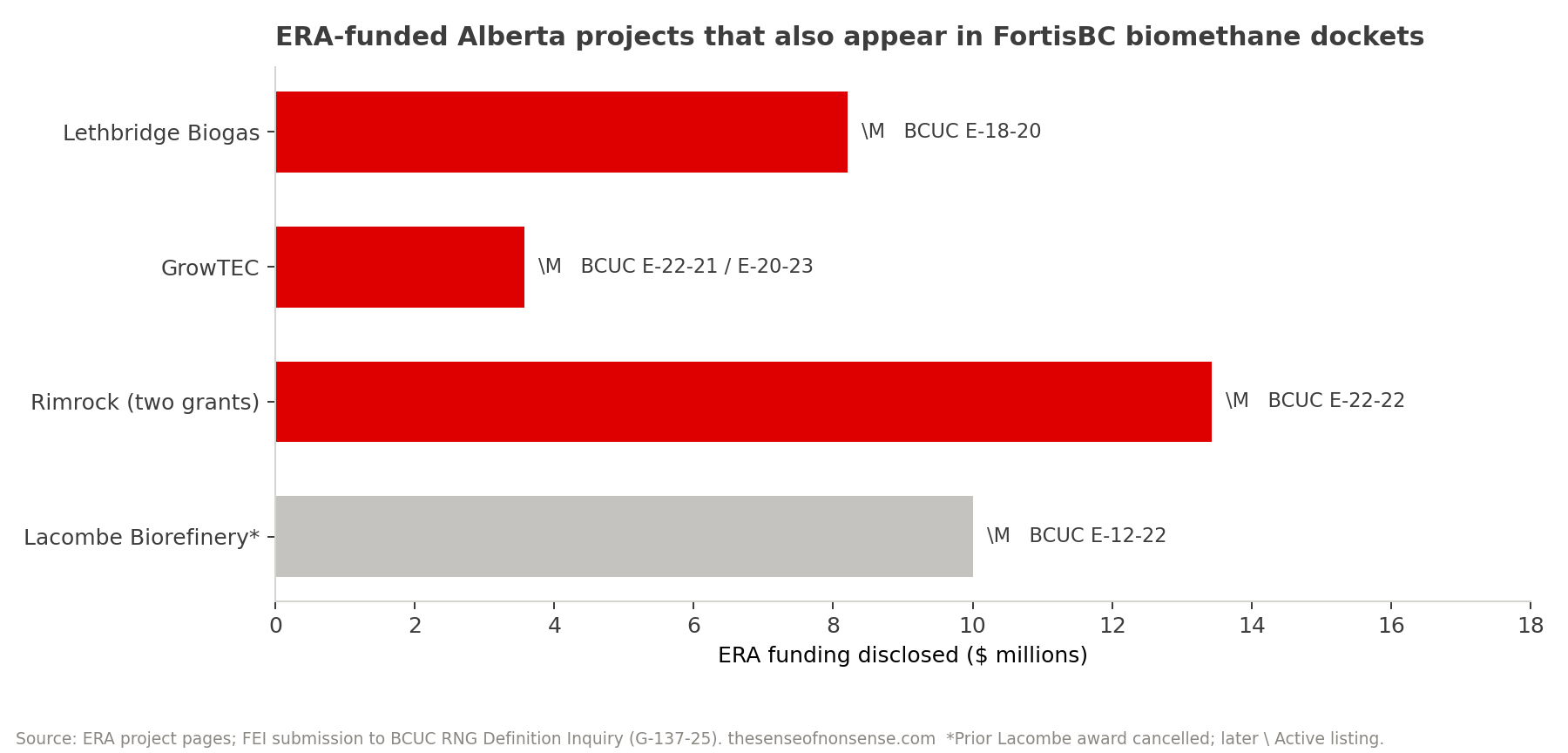
Four Alberta names that appear on both ERA’s project list and FortisBC’s biomethane docket table.
Central Farms RNG, a $10 million Contribution Agreement on ERA’s current list, does not appear in the BCUC table yet. It belongs in the same class of project: pipeline-grade renewable gas is an attribute product by design. Watch the dockets.
Two-track attribute policy, one public silence
Here is the part that made me re-read the contribution language twice.
On some ERA programs, the agency is explicit that it keeps the environmental attributes. The Energy Savings for Business Expanded Technologies Pilot guidelines require transfer of ownership to ERA of “all environmental attributes, including but not limited to carbon offset credits, and any environmental products that are created or otherwise arise from the Project regardless of jurisdiction.” The ESB contribution agreement template says the same thing in contract form, and adds that ERA may deal with those attributes unilaterally. The Methane Reduction Deployment Program guide has a parallel clause. SEMI’s public FAQ answers “Does ERA keep the environmental attributes?” with yes, for Capital Retrofits.
That is a coherent design: public money in, public claim retained.
I have not found the equivalent public clause for the big Continuous Intake / challenge demonstration agreements that funded Lethbridge, GrowTEC, and Rimrock. What I have found, in older challenge guidelines, is language saying ERA will not match offset credits or emission performance credits associated with a project, which treats those credits as value sitting with the proponent. The facilities above then appear in BC filings as sellers of biomethane attributes. The simplest reading of the public record is that, for those demonstration deals, the attributes stayed with the project owners.
I have not seen ERA publish a single ledger that would let an Albertan look up a funded project and see who currently owns the tonne. Until that exists, “paid in Alberta, claimed everywhere” describes the architecture on the public record.
The province already said the attributes leave
I did not invent the export story. Alberta’s government wrote it into its own climate plan.
The 2023 Emissions Reduction and Energy Development Plan, under bioenergy achievements, states:
Alberta is supporting emissions reductions in other jurisdictions. Most of the bioenergy produced in Alberta, particularly RNG, is shipped to British Columbia for transportation and natural gas heating.
That sentence sits on page 44 of the plan, in the same section that lists TIER-offset protocols for landfill gas, manure, and wastewater, and a few paragraphs before the plan names ERA-backed RNG and biofuels projects as ongoing actions. The government is describing the architecture as a feature: Alberta produces the gas; other jurisdictions get the climate credit.
BioAlberta’s 2023 Bioenergy Position Paper, written as a response to that plan, sharpens the ledger point without softening it:
The Alberta Emissions and Energy Development Plan correctly points out that most all the RNG produced in Alberta (except for on-farm heating or electricity generation) is used in other jurisdictions. Producing low carbon environmental attributes for other jurisdictions does not benefit Alberta’s decarbonization ambitions when they are used elsewhere.
Read that slowly. The provincial plan admits the shipment. The industry association admits the consequence: when the environmental attributes are used elsewhere, they do not serve Alberta’s own decarbonization ambitions. The BCUC table in this instalment is the contract trail for that admission. Displacement delivery at AECO/NIT is how the paper moves. The tonne that matters for CleanBC is the attribute, and the attribute leaves.
Who gets to claim the tonne
There are at least three paper objects people conflate when they talk about “double counting.”
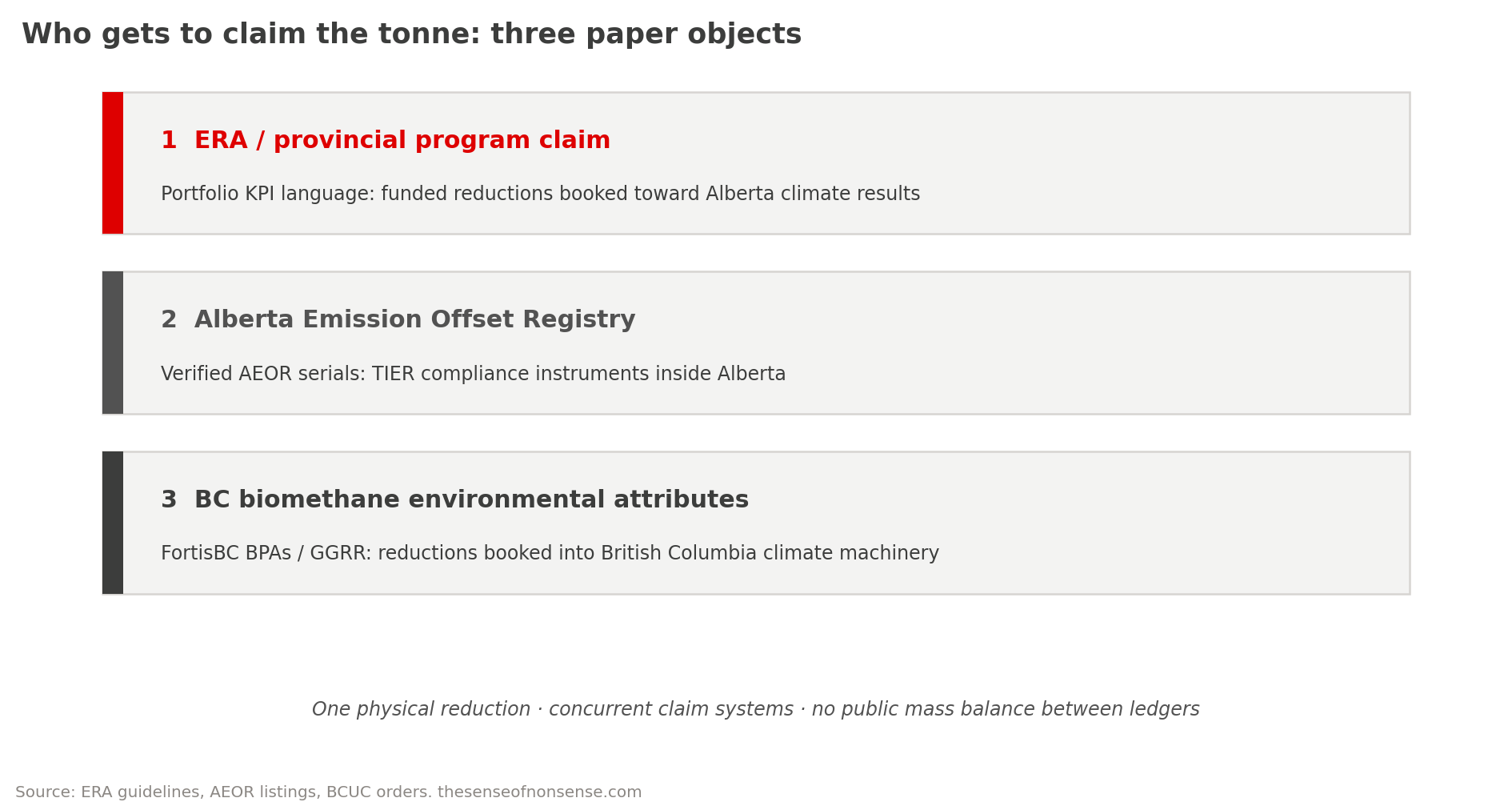
Three paper objects. One atmosphere.
The first is a program claim: ERA or the province says a funded project reduces Y tonnes, or that the ERA portfolio supports tens of megatonnes by 2030. That is accountability language: a different paper object from an AEOR serial, and a different object again from a GGRR retirement. The same EREDP that admits RNG leaves for British Columbia also says ERA projects “will support 41 Mt of emission reductions by 2030 and 105 Mt by 2050.” Those numbers sit in the provincial plan as Alberta climate results.
The second is an Alberta offset serial on the Emission Offset Registry: a verified tonne that can be retired for TIER compliance.
The third is a biomethane environmental attribute sold under a FortisBC Biomethane Purchase Agreement and booked into British Columbia’s climate machinery.
The public file does not give a mass balance that would identify serial X on the AEOR with gigajoule Y under a BPA, and the later Alberta BPA contracts try to forbid selling the same biomethane attributes into carbon markets more than once. What the public file does show is quieter and, for Alberta’s climate accounts, more damaging.
On the challenge-class digesters that now appear in BC dockets, the public guidelines leave the attributes with the project owners. Those owners then sell the attributes into another jurisdiction’s compliance system. Alberta’s own plan admits that most RNG attributes leave. And Alberta continues to book the funded projects toward provincial and agency reduction claims. One physical reduction. Two ledgers wanting the credit. When that happens, one of the programs being sold into did not actually get a unique tonne. The atmospheric work happened once. The accounting happened twice.
That is the double-claim problem that does not require matching a serial to a gigajoule. It requires only what the province has already written: attributes leave, and the funded reductions stay on Alberta’s scoreboard.
On some ERA incentive programs, as noted above, the agency knows how to stop that. It takes title. On the demonstration class that built the export cases, the public file shows no equivalent lock and no public attribute ledger after the money goes out. Post-commissioning, ERA requires a measurement plan and, one year after commissioning, a third-party verification report to verify the emissions reductions. That verifies a GHG number for the funder. It does not publish who owns the transferable attribute, whether that attribute was sold into British Columbia, California, a federal fuel credit market, or kept for the proponent’s own compliance, or whether the tonne ERA still cites in portfolio marketing is the same tonne someone else retired.
When the province books the reduction and the project owner sells the transferable attribute, uniqueness fails for one of the ledgers.
Jobs on the scorecard, stories on the ledger
Jobs sit beside carbon on the scorecard ERA uses on the way in, and they soften on the way out.
In the Industrial Transformation Challenge and Advanced Materials Challenge guidelines now on the public record, proposals are evaluated partly on socioeconomic benefits: employment opportunities, economic activity, investment attraction. That criterion carries fifteen to twenty-five points out of a hundred, depending on the call. ERA’s external-reviewer solicitation lists “Socioeconomic impact assessment” beside “GHG Quantification” as a skill it recruits to score applications.
After the award, the same guidelines require recipients to “report on” job creation. Watch what the next sentence does. Only projects with quantifiable GHG benefits must file a measurement, monitoring, and verification plan. Only GHG gets the FAQ line that a third-party verification report is required one year after commissioning “to verify the emissions reductions.” Jobs are, in ERA’s own verbs, “collected and publicly reported.”
What the public then sees is a modelled portfolio aggregate: tens of thousands of “person-year jobs by 2025” or “by 2027,” produced for ERA by an Alberta Innovates economic-impact analysis and revised upward as ERA commits more dollars. There is no project-by-project true-up of jobs promised against jobs delivered in that package. The 2023 provincial plan recycles the same framing. The one completed-project final report I have walked end to end for this series, GrowTEC’s 2016 CCEMC close-out, quantifies GHG projected versus actual with an outside firm and treats non-GHG benefits as narrative. It does not report a job count.
Employment may well be real. The public control that exists for the tonne does not exist for the job, even though both were scored when the money was awarded. Predicted jobs help a proposal win. Delivered jobs are not independently verified in anything I can find on the public file.
What Ottawa counts differently
A fair contrast with federal programming is narrower than the folklore version, and it still matters.
Ottawa’s Low Carbon Economy Challenge, when it funds low-carbon fuel production, generally requires the fuel to be primarily for the recipient’s own use. Excess can be sold. But emission reductions from fuel sold to third parties are treated as downstream Scope 3 tonnes and are out of scope for the program’s GHG workbook. Canada, as funder, declines to count the sold portion toward its Challenge KPI. That is an eligibility and accounting rule: sold credits can still move; the Challenge workbook simply refuses to put exported attribute tonnes on the funder’s scoreboard.
Natural Resources Canada’s Clean Fuels Fund capital stream goes the other way on monetization: contribution guides fold the value of government credits from offsets and regulations into project profit and repayability calculations. Those grants assume credit revenue. They do not lock attributes for the recipient’s own compliance.
The federal rule that actually forbids transfer is a different instrument entirely. Under the Clean Fuel Regulations, compliance credits created by paying into a registered emission-reduction funding program cannot be traded and expire if unused for that compliance period. That is a compliance-fund mechanism for fuel suppliers. It sits apart from the term sheet for a capital grant to an RNG plant.
So the accurate comparison is this. On some streams, ERA takes attributes. On the demonstration class that exported biomethane attributes to British Columbia, the public guidelines do not. Ottawa’s Challenge workbook at least refuses to count sold fuel toward the federal KPI. Alberta’s plan admits the attributes leave and still cites ERA portfolio megatonnes as provincial climate results. The missing control is local.
The note that stopped being published
Part 4 promised the paper trail that stopped being published. Here it is, and it is almost charming in its bluntness.
For years, ERA’s financial statement notes carried a geographic disclosure. The FY2022 wording:
Included in the project expenses for the current year is $98,920 (2021 - $299,907) paid to projects being developed in Canada, but outside of Alberta. No expenses were paid to projects being developed outside of Canada in the current year (2021 - nil).
I walked that sentence backward through the annual reports. The series looks like this, in dollars paid out that year:
| Fiscal year (ended May 31) | Canada, outside Alberta | Outside Canada |
|---|---|---|
| 2017 | 527,083 | 487,341 |
| 2018 | nil | 80,821 |
| 2019 | 5,449,041 | 217,218 |
| 2020 | 4,350,000 | 59,718 |
| 2021 | 299,907 | nil |
| 2022 | 98,920 | nil |
| 2023 | (not disclosed) | (not disclosed) |
| 2024 | (not disclosed) | (not disclosed) |
The “(not disclosed)” cells are the finding. The FY2023 and FY2024 standalone financial statements, and the annual reports that cover those years, no longer carry the sentence. I searched the extracted text for the old phrasing. It is gone.
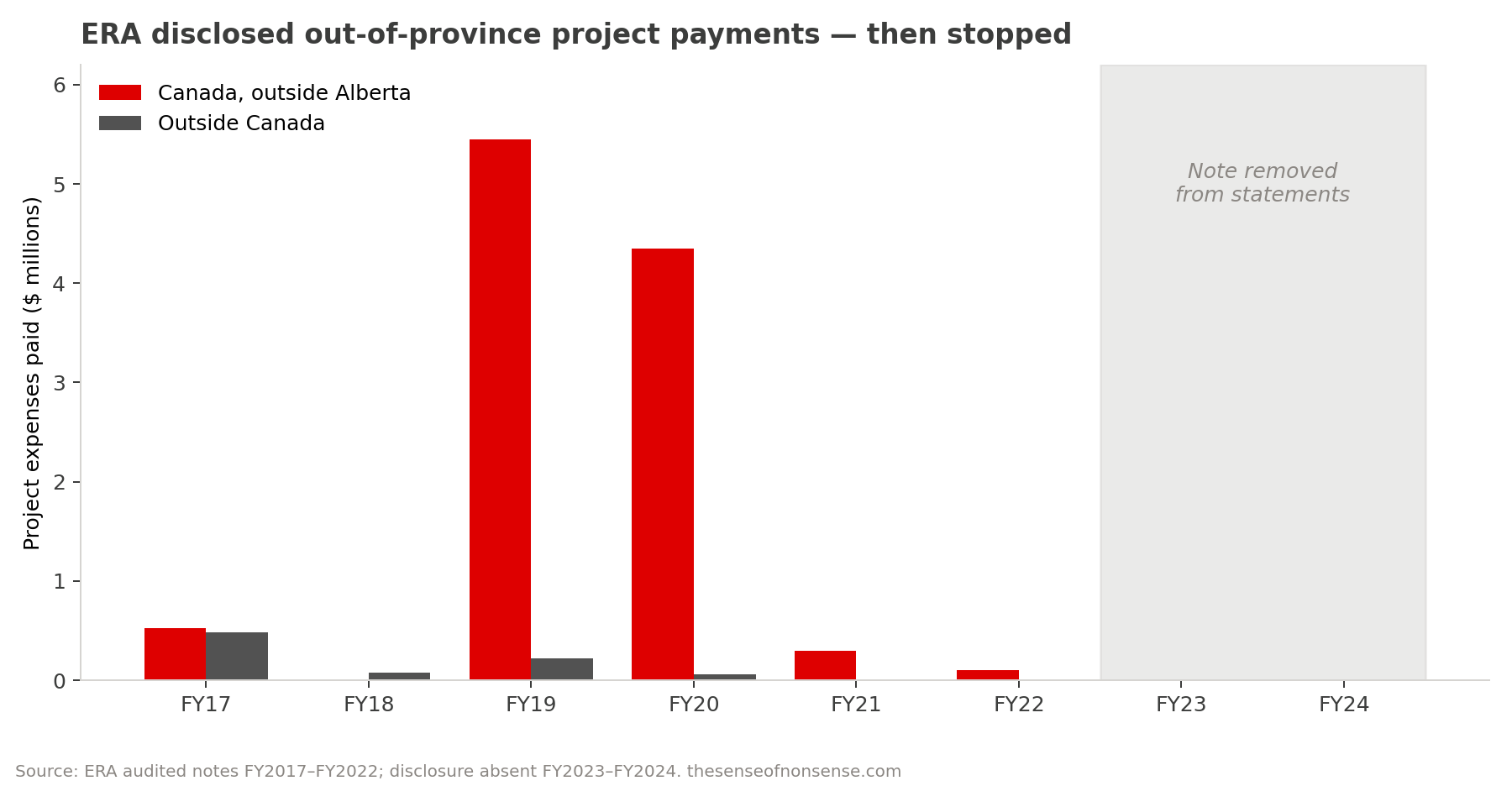
A note that ran for years, then did not.
Commitments told a louder story than annual payments in the middle years: tens of millions approved for projects developed outside Alberta, and for a stretch eight-figure commitments outside Canada entirely. By FY2021 and FY2022 those commitment balances had collapsed, and the annual cash leaving the province for out-of-province project locations was small change next to ERA’s float. An earlier annual report even shrugged that out-of-province projects were under five per cent of total investment.
So why care about a vanished $99,000 line?
Because it was the one place in the audited package where a reader could see, without reconstructing a project database, whether industrial carbon money was leaving Alberta as spend. When the figure got small, the disclosure did not shrink with it. It disappeared. A reader of the FY2024 statements cannot tell whether out-of-province project payments were zero, immaterial, or simply no longer reported. That is a choice about what the public is allowed to know.
(I do not yet have the FY2025 statements in hand for this check. When they land, I will look for the sentence.)
Concession
Displacement contracts and multi-jurisdiction RNG are ordinary market design. Molecules travel by contract rather than passport, AECO/NIT is a real trading hub, and BC’s regulator has repeatedly accepted out-of-province biomethane under its reading of the GGRR. A digester in Lethbridge that keeps manure methane out of the air is doing real atmospheric work wherever the attribute certificate ends up. Innovation funders everywhere fund technology that later sells into someone else’s compliance market. Small provinces share infrastructure. Expertise concentrates. None of that is invented for this series.
The missing public control remains after those concessions. Alberta collects TIER dollars on the promise that industry’s carbon costs buy emissions reduction for Alberta’s climate accounts. ERA, on some programs, knows how to retain attributes in contract form. On the demonstration projects that now show up in BC dockets, the public file does not show that retention. The province’s own plan admits most RNG attributes leave for British Columbia, and the industry association says those attributes do not serve Alberta’s decarbonization ambitions when used elsewhere. The offset registry and the BCUC docket can describe the same facility without anyone publishing a reconciliation. Jobs that helped proposals win funding are scored on the way in and modelled on the way out, without the third-party check ERA requires for the tonne. And the one audited sentence that tracked cash leaving the province for out-of-province project development was retired just as the attribute-export story got interesting.
A tonne that can be funded in Edmonton, serialized in Alberta, and claimed in Vancouver is a tonne whose owner is whoever’s paperwork is better, unless someone keeps a ledger.
I have not seen ERA publish that ledger. I have not seen the ministry require it. The BCUC is at least asking the double-counting question out loud. Alberta’s industrial carbon system has yet to put the same question on its own public record.
Next: the small world of who sits on the board, who gets funded, and what the public record will support without inventing motives.
If I have misread a line item or a docket, the documents are linked below; show me and I will correct it.
Sources
- Emissions Reduction Alberta, project page: Lethbridge Biogas/Cogeneration Project ($8.2M funding; Round 1; completed; 2020 biomethane expansion note; 2022 Skyline acquisition). eralberta.ca
- Alberta Emission Offset Registry, Lethbridge Biogas Offset Project (ProjectId=184): Biogas Production and Combustion protocol; Active; offset window 2013-12-01 to 2026-11-30; public totals as displayed on listing detail. alberta.csaregistries.ca
- BCUC Order E-18-20 (24 June 2020), FortisBC Energy Inc. filing of Biomethane Purchase Agreement with Lethbridge Biogas LP, accepted; facility in Lethbridge, Alberta; notional delivery at AECO/NIT. FortisBC regulatory PDF.
- FortisBC Energy Inc. submission to BCUC Review of RNG Definition and Accounting Inquiry (Order G-137-25, established 5 June 2025): table of out-of-province BPA acceptances including Alberta rows E-18-20, E-24-20, E-22-21, E-12-22, E-22-22, E-20-23. Proceeding: bcuc.com application 1355
- ERA project page: Source Separated Organics and Agricultural Waste Anaerobic Digester (GrowTEC / Growtec), $3.57M, Completed, Coaldale. eralberta.ca
- AEOR company listing, Grow the Energy Circle Ltd. (CompanyId=92): GrowTEC Biogas Offset Project 7938-6553, Inactive, offset end 2023-07-31. alberta.csaregistries.ca
- FortisBC GrowTEC Biomethane Purchase Agreement materials; BCUC Orders E-22-21 and E-20-23; amending agreement filing (Coaldale seller; Offset / environmental attribute definitions). fortisbc.com regulatory
- ERA project pages: Rimrock Renewables digestate / AD prototype ($8.43M, Active) and New Production System ($5.0M, Active). eralberta.ca
- Contemporary reporting on Rimrock High River biogas / FortisBC offtake and ERA grant totals: CBC News, Calgary, 2023. cbc.ca
- ERA project pages: Lacombe Biorefinery (Cancelled; Continuous Intake / 2020 announcement; cancelled 2023) and later Active BioRefinex listing ($10M). eralberta.ca
- ERA project database scrape used for this series (working extract held with the investigation notes), including Central Farms RNG ($10M, Contribution Agreement). Live browse: eralberta.ca/projects/.
- ERA audited / summary financial statements and annual reports, years ended May 31, 2018 through 2022: out-of-province project expense and commitment notes as tabulated above. PDFs: eralberta.ca annual reports. FY2022 note text as quoted from FY2022 FS / 2021-22 AR.
- ERA Financial Statements FY2023 and FY2024 (standalone PDFs on eralberta.ca): geographic “outside of Alberta” project-expense disclosure absent from extracted text.
- ERA Energy Savings for Business Expanded Technologies Pilot Guidelines §8 (Environmental Attributes) and Contribution Agreement template §15.1. eralberta.ca; template PDF
- ERA Methane Reduction Deployment Program Guide §3.4 (Environmental Attributes). eralberta.ca
- ERA SEMI FAQ (“Does ERA keep the environmental attributes?”). eralberta.ca/semi/frequently-asked-questions
- ERA Oil Sands Innovation Challenge guidelines (2017): ERA will not match offset credits or EPCs associated with the project. eralberta.ca PDF
- AEOR public listing header (416 projects as of research pull). alberta.csaregistries.ca
- Facility claim matrix and forensic memo (AEOR serial destinations x FEI BPA environmental-attribute language; Lethbridge, GrowTEC, Rimrock, Lacombe): investigation notes under the Part 5 carbon-accounting file, including GrowTEC Transaction Confirmation warranties and AEOR ProjectId 184 / 173 serial summaries as scraped 2026-07-11.
- Alberta Director Notice, Avoidance of Double Registration in Alberta Emission Offset System and WREGIS (22 April 2024): concurrent AEOS/WREGIS enrolment allowed only with MWh allocated to one system or the other. alberta.ca PDF
- Government of Alberta, Emissions Reduction and Energy Development Plan (2023), Part Five (bioenergy), p. 44: “Alberta is supporting emissions reductions in other jurisdictions. Most of the bioenergy produced in Alberta, particularly RNG, is shipped to British Columbia for transportation and natural gas heating.” Also ERA portfolio framing (person-year jobs; 41 Mt by 2030 / 105 Mt by 2050). open.alberta.ca PDF
- BioAlberta, Bioenergy Position Paper (2023): attributes used in other jurisdictions “does not benefit Alberta’s decarbonization ambitions when they are used elsewhere.” bioalberta.com PDF
- ERA Call 15 / Industrial Transformation Challenge EOI Guidelines and FAQs (2025-2026): Non-GHG / Economic & Environmental Benefits scoring weights; outcomes reporting clause; third-party verification report one year after commissioning “to verify the emissions reductions”; jobs “collected and publicly reported.” eralberta.ca
- ERA annual and stewardship reports (2021-22 through Mar 2026 stewardship): Alberta Innovates Economic Impact Analysis person-year job and GDP aggregates. eralberta.ca
- Environment and Climate Change Canada, Low Carbon Economy Challenge Applicant Guide 2023 §§3.3.5-3.3.6: own-use fuel rules; sold low-carbon fuel treated as Scope 3 and out of scope for the Challenge GHG workbook. canada.ca
- Natural Resources Canada, Clean Fuels Fund / Building new domestic production capacity applicant guide §3.2.1: government credit values (offsets and regulations) included in project profit and repayability. natural-resources.canada.ca
- Clean Fuel Regulations (SOR/2022-140) ss.118-119 and ECCC compliance guidance: compliance-fund credits created by contribution to a registered funding program cannot be traded and expire if unused for that compliance period. canada.ca