
Part 6 of The TIER Files, a series that follows Alberta’s industrial carbon money from the smokestack to wherever it actually ends up.
Everything here comes from audited financial statements, ERA’s own project database and board materials, and other public documents. Sources, with page numbers and URLs, are at the bottom. This instalment maps relationships drawn from those public bios and releases. It does not claim that any relationship caused any funding decision.
Start with one walk you can do without leaving ERA’s own website.
Kathleen Chisholm is the current vice-chair of Emissions Reduction Alberta. Her ERA board biography says she spent roughly 2009 to 2024 as Capital Power’s Senior Vice-President and Chief Legal and Sustainability Officer, and that she has recently retired from that role. Capital Power, in ERA’s project database, shows as the recipient on two completed projects: Genesee CCS, with $5.0 million in ERA funding, and the Genesee wood-waste biomass co-firing project, with $326,000. Combined, $5.33 million. The database marks both Completed. ERA appointed her a director effective May 1, 2023.
The chronology is tight enough to state without hedging. ERA announced the Genesee biomass award on July 7, 2017, and the Genesee CCS kickstart award on July 13, 2022. Both awards predate her board seat. The April 2023 appointment release still lists her as serving at Capital Power when she joins, so employment at the recipient and ERA board tenure overlapped after the funding decisions. The walk the public record supports is chronological: employer funded first; director later; for a stretch, both at once. The awards predate the seat. The public record supports co-occurrence and chronology.
Once you have seen one of those walks, you start looking for the next.
How the map was built
The method is dull on purpose. Every person named below appears on ERA’s board page, in an ERA media release, or in a remuneration note. Every funded-company link comes from ERA’s WordPress project database (469 records as scraped), matched to those bios and to portfolio pages the venture firms publish themselves. Every commercial link to another organization comes from ERA’s audited statements. Each edge gets a date range where the source allows one, and a confidence note where it does not. Connection is the finding. Causation is a different claim, and this piece does not make it.
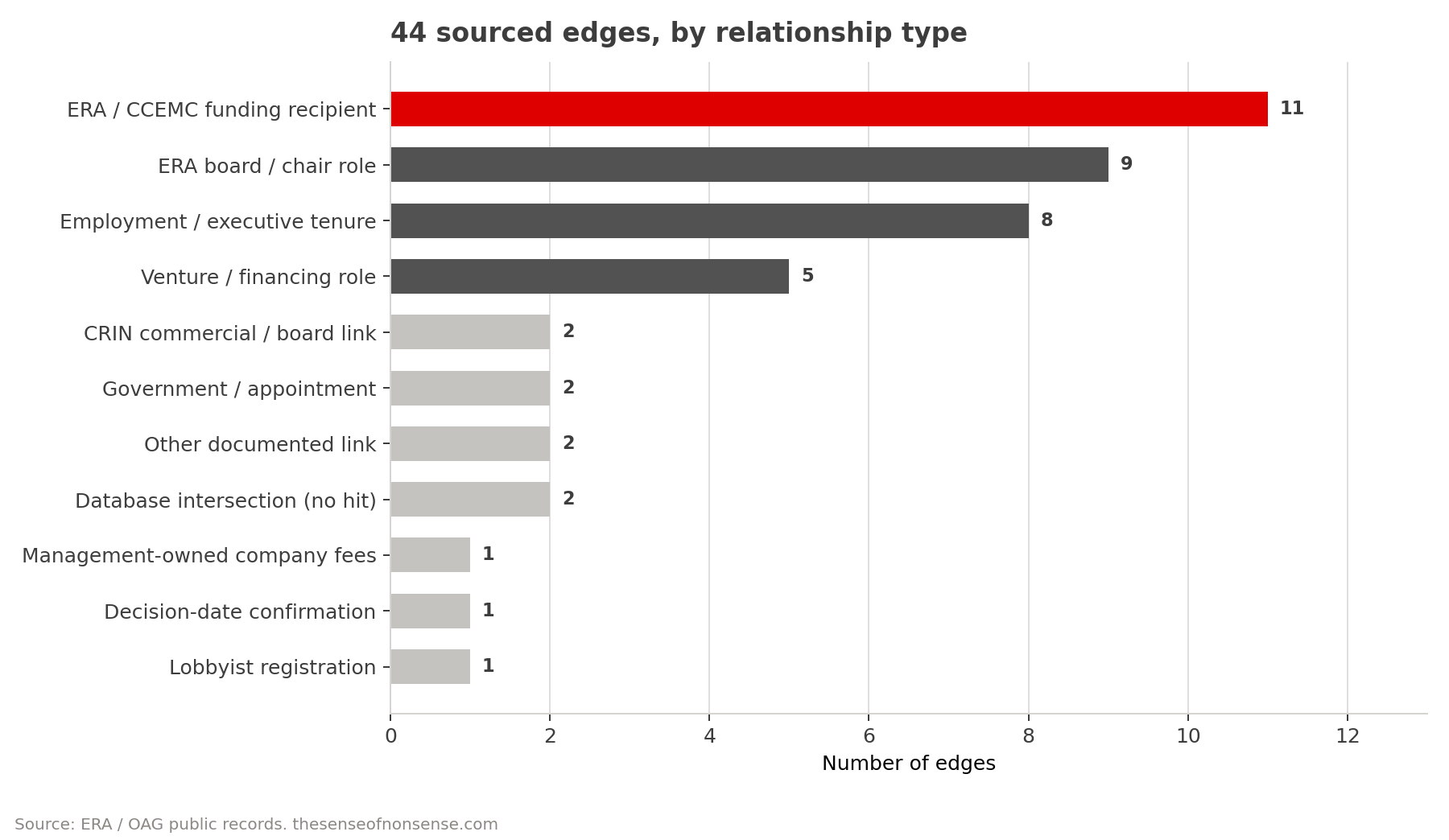
How the forty-four edges sort when you stop reading them one at a time.
Challenge-announcement dates for the three original retrospective edges are now lined up against appointment releases (sources below). The relationships below are drawn from public bios, appointment releases, and the project database. Corrections are welcome.
The pipeline to the boardroom
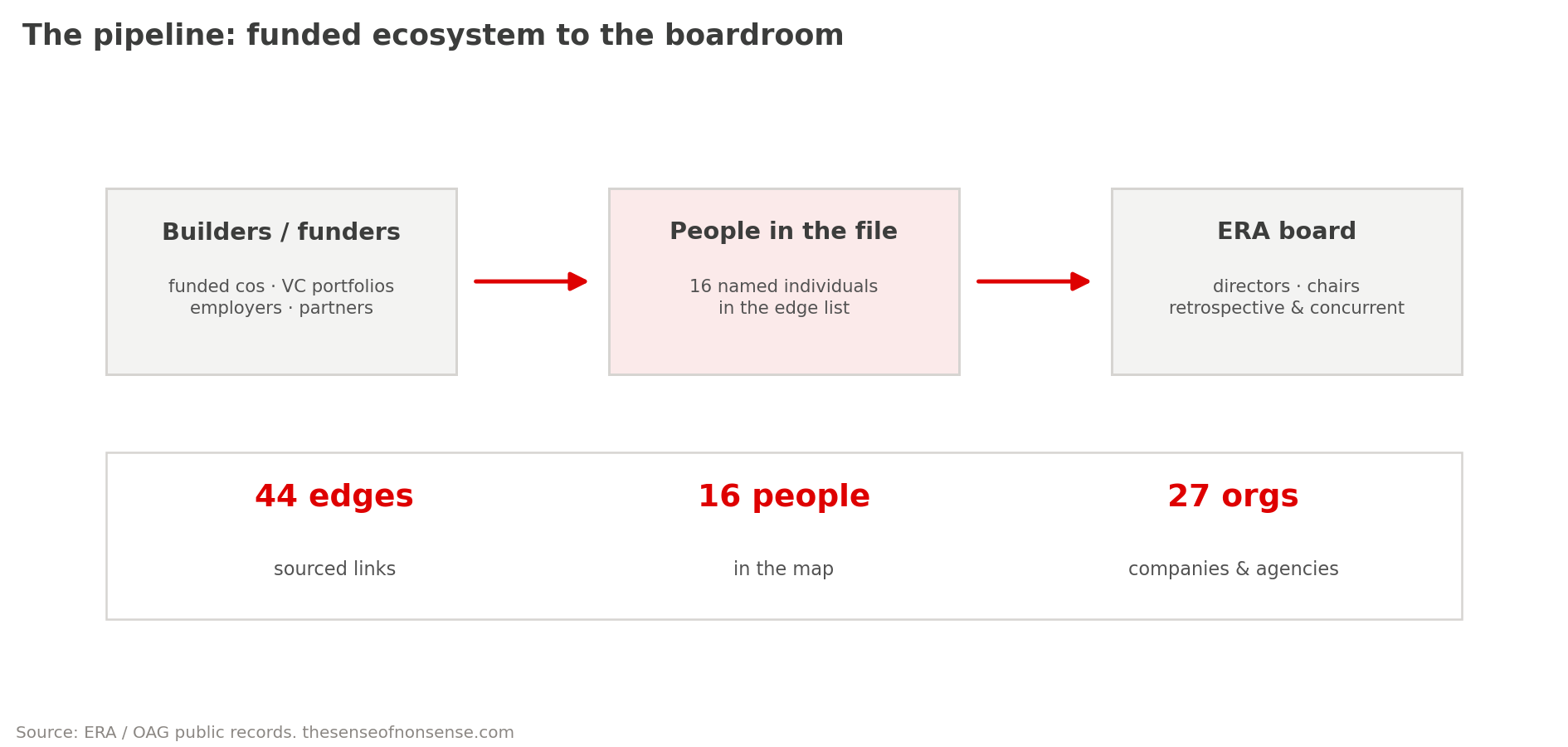
Builders and funders first; directors later. Forty-four sourced edges on the map.
Three current directors, same shape of edge.
Chisholm and Capital Power, as above: $5.33 million across two completed projects; executive tenure at the recipient precedes the board seat.
Mark Blackwell and Skyonic. His ERA bio says that while he was an investment manager in Cenovus’s corporate venture fund, he “led the financing” of Skyonic Corporation and sat as Board Observer. Skyonic appears in the project database with a completed CCEMC-era SkyCycle pilot at $425,000 in funding; the award sits in April 2014. ERA appointed him a director effective May 1, 2023, the same cohort as Chisholm. Same retrospective structure: funding and private-side involvement first, funder board seat later, about nine years apart. His former employer, Cenovus, has seven entries of its own in the same database (two completed with listed funding, and a thicker file of terminated, cancelled, and never-initiated rows).
Sarah Applebaum and CarbonCure, via Pangaea. She is a Partner at Pangaea Ventures; Pangaea’s public portfolio page lists CarbonCure Technologies; CarbonCure has two completed ERA projects in the database, $2.24 million and $3.0 million, for $5.24 million combined. ERA announced those awards on March 1, 2017 and October 30, 2019. Her ERA board appointment lands around June 2025, after a committee role from October 2023. Again: portfolio company funded, partner later on the funder’s board.
Individually, each of those walks is ordinary in a small province with a thick energy-and-climate professional class. Collectively they are a pattern you can count: the funded ecosystem is where a meaningful share of ERA’s current directors now come from. Three documented retrospective edges on a board that the FY2025 annual report describes as having received five new members is enough of a concentration to put on the map and leave alone.
There is also a concurrent portfolio edge that belongs in a different column from the retrospectives. Blackwell’s later affiliation is Builders VC. Future Fields, listed in that portfolio reconstruction, received about $4.09 million through ERA’s Industrial Transformation Challenge, announced February 13, 2025, while Blackwell has sat on the ERA board since May 1, 2023. The database marks the project Active. That is documented co-occurrence: a funder’s director whose venture world overlaps a live award. Co-occurrence is what the public record supports today. Whether a recusal sits in a file a citizen can eventually see remains an open question for ERA.
Dr. Monica Gattinger’s ERA bio lists her, presently, as a board member of the Clean Resource Innovation Network. ERA’s FY2021 and FY2022 statements disclose a competition coordination agreement with CRIN (executed February 10, 2021) and CRIN-related revenue of $58,658 and then $563,019. The FY2023 statements say that agreement ended in FY2021-22 and that the receivables were collected; CRIN revenue is $0 in the FY2023 comparative, and no CRIN line appears in the FY2024 statements text pulled for this investigation. Concurrent board seats remain on the public record. On the evidence so far, the commercial counterparty relationship has closed.
Who chaired the room
The chair lineage is the sector’s own C-suite, drawn from ERA’s releases rather than from anyone’s speculation.
Kathleen Sendall chaired from 2014 through September 2018, hired CEO Steve MacDonald, and ran the rebrand from CCEMC to ERA. David Collyer chaired from October 1, 2018 to September 30, 2023. Before the chair, he was President and CEO of the Canadian Association of Petroleum Producers, and before that President and Country Chair of Shell Canada. For five years, the board of Alberta’s clean technology funding corporation was chaired by the former head of the oil and gas producers’ lobby. That sentence is ERA’s own chronology, compressed.
David Moss, a director since July 2019, was appointed interim Board Chair by the Government of Alberta from October 2023. The current chair, Kelly J. Ogle, is CEO of the Canadian Global Affairs Institute; fellow director Kevin Birn is a Fellow of the same institute. Stephanie Clarke’s ERA bio runs through senior Government of Alberta roles, including ADM Resource Stewardship at Environment and Parks, the ministry that funds and oversees the agency. The government appoints the board. One of the directors is a former senior official from the appointing ministry’s orbit. That loop is structural, and it is disclosed in the ordinary language of bios and appointment releases.
The gatekeepers on the intake page
ERA publishes a Trusted Partners roster: Government of Alberta, Alberta Innovates, Canada Infrastructure Bank, Export Development Canada, Genome Alberta, Métis Settlements Development Corporation, Natural Resources Canada, NGIF Accelerator, NorthX Climate Tech, PTAC, PrairiesCan, and Results Driven Agriculture Research (RDAR). The FY2025 annual report says four new trusted partners were welcomed that year. These are the referral and collaboration gatekeepers around Continuous Intake and the challenge machinery.
The public page stops at the roster. I have not found, in a form a reader can use, a per-partner count of how many funded projects arrived through each gate. Referral concentration would be a finding even with zero personal overlaps between partner boards and funded companies. The roster is visible; the statistics that would let a reader audit the roster stay unpublished. (Director Stuart Cullum’s bio also lists a board seat at the Canadian Agri-Food Automation and Intelligence Network; CAAIN is absent from the current Trusted Partners list. Adjacent, dated, and noted for the follow-on map rather than stretched here.)
The part where I’m fair about it
Alberta is a small province with a thick energy-and-climate professional class, and expertise concentrates. A board that knows the industry is partly the design of a technology funder that evaluates industrial projects. Judgment drawn from people who have run generators, sat on venture boards, and worked inside the ministry is what that design buys. Overlap is what you get when the same few hundred practitioners do the work for twenty years.
The concession covers the existence of the edges. The public architecture that is supposed to make a small world safe still has to be shown: published recusal records, a conflict register a citizen can read without filing a FOIP, referral statistics by Trusted Partner, and decision dates that line up cleanly against appointment dates without a freelance scrape of 469 project pages. Small ecosystems need denser disclosure architecture, because the alternative is asking the public to take the hygiene on faith.
The network is allowed. The invisible recusal ledger is the problem.
ERA’s privacy policy references a Conflict of Interest Policy by name. The policy document itself, and any recusal register that sits under it, have not turned up in the public materials I have been able to read. That may mean they exist behind a request. It may mean they exist for internal use only. Either way, the citizen reading the board bios and the project database side by side is doing conflict analysis the long way around, which is a strange place to leave a compliance-levy funder seventeen years in.
The names the notes still withhold
One edge on this map is already in the audited statements and still refuses to resolve into proper nouns. From fiscal 2017 through fiscal 2025, the remuneration notes disclose a steady stream, roughly $290,000 to $333,000 a year, about $2.75 million cumulative, paid to counterparties the later wording finally calls “companies owned by senior management who report directly to the board.” The notes leave the companies unnamed. They leave the managers unnamed. Corporate registries will, eventually. That identification, and the fifteen-year governance history around the same note, is the next instalment’s job (and a follow-on map piece after it). This one stops at the shape of the edge: the people who run the agency own companies, the agency pays those companies, and the public record’s entire account of the arrangement is one sentence and a number per year.
That is enough map for one sitting. The funded ecosystem feeds the boardroom. The chair line runs through the sector’s own leadership. The Trusted Partners sit on the intake page without published referral counts. A concurrent Builders-Future Fields edge sits beside the retrospectives as documented co-occurrence; the public file does not yet show a recusal record for it. The CRIN commercial wire is historical; the dual board listing is current. And the management-owned companies sit in the notes like a door with the nameplate removed.
Next: the companies the board pays itself, read across fifteen years of the same note. Then the names those notes still withhold.
If I have misread a relationship or a date, the documents are linked below; show me and I will correct it.
Sources
- ERA board biographies and roster: eralberta.ca/about-era/the-board/ (Chisholm / Capital Power tenure; Blackwell / Skyonic financing and Board Observer language; Applebaum / Pangaea; Gattinger / CRIN board listing; Ogle / CGAI; Birn / CGAI Fellow; Clarke / GoA career; Cullum / CAAIN).
- ERA project database scrape, 469 records, captured 2026-07-11 from ERA’s public WordPress API and project pages: Capital Power (Genesee CCS, $5,000,000, Completed; Genesee Wood Waste Biomass Co-Firing, $326,000, Completed); Skyonic Corporation (SkyCycle Pilot Demonstration, $425,000, Completed); CarbonCure Technologies ($2,240,000 and $3,000,000, both Completed); Future Fields (Industrial Transformation Challenge / related ITC 2024 listing, about $4.09 million, Active); Cenovus Energy Inc. and related recipient strings (seven database entries as scraped). Project URLs on eralberta.ca/projects/.
- Challenge and appointment chronologies: ERA Methane Challenge release, 2017-07-07 (Genesee biomass); ERA Carbon Capture Kickstart release, 2022-07-13 (Genesee CCS); Skyonic SkyCycle final report / CCEMC award timing, April 2014; ERA Grand Challenge releases, 2017-03-01 and 2019-10-30 (CarbonCure); ERA board appointment release, 2023-04-19 / effective 2023-05-01 (Chisholm, Blackwell); Applebaum board timing about 2025-06 (committee from Oct 2023); Future Fields / ITC announcement, 2025-02-13. Working chronology held with the investigation notes.
- Pangaea Ventures portfolio listing for CarbonCure Technologies: pangaeaventures.com/portfolio (fetched 2026-07-11). Builders VC and ERA portfolio reconstruction for Future Fields: working notes held with the investigation file.
- ERA media releases on board chair appointments and transitions: Sendall chair era and rebrand/CEO hire; Collyer appointment (Oct 1, 2018) and completion (Sep 30, 2023), including prior CAPP and Shell Canada roles as stated in ERA materials; Moss interim chair appointment language (“appointed interim Board Chair for ERA by the Government of Alberta”), Oct 2023. eralberta.ca
- ERA Annual Report 2025: five new board members appointed; Trusted Partners welcome language (“Welcomed four new trusted partners”).
- ERA Trusted Partners page (roster as refreshed 2026-07-11 from the public page): Government of Alberta, Alberta Innovates, Canada Infrastructure Bank, Export Development Canada, Genome Alberta, Métis Settlements Development Corporation, Natural Resources Canada, NGIF Accelerator, NorthX Climate Tech, PTAC, PrairiesCan, Results Driven Agriculture Research (RDAR). eralberta.ca
- ERA Financial Statements FY2021 and FY2022: competition coordination agreement with CRIN executed February 10, 2021; CRIN-related revenue $58,658 (FY2021) and $563,019 (FY2022). FY2023 statements: agreement ended FY2021-22; receivables collected; CRIN revenue $0. FY2024 statements: no CRIN revenue line located.
- ERA Financial Statements FY2017 through FY2025, remuneration notes: fees to contract management / companies owned by senior management who report directly to the board ($287,595 to $333,455 per year; about $2.75M cumulative FY2017 through FY2025). Identities of the companies are not disclosed in the notes.
- ERA privacy policy reference to a Conflict of Interest Policy (policy document and any public recusal register not located in materials reviewed for this draft).
- Working edge list held with the investigation notes (44 sourced edges as of second deep pass; this article draws from that file and the sources above).