
Part 2 of Ghost Lives. Part 1 followed FortisBC’s premium and the BCUC record. This instalment follows one gram of carbon dioxide equivalent through every ledger that claims it.
Figures and program facts are taken from audited statements, provincial climate plans, BCUC filings, the Clean Fuel Regulations and Environment and Climate Change Canada guidance, and the Alberta Emission Offset Registry. Sources are at the bottom.
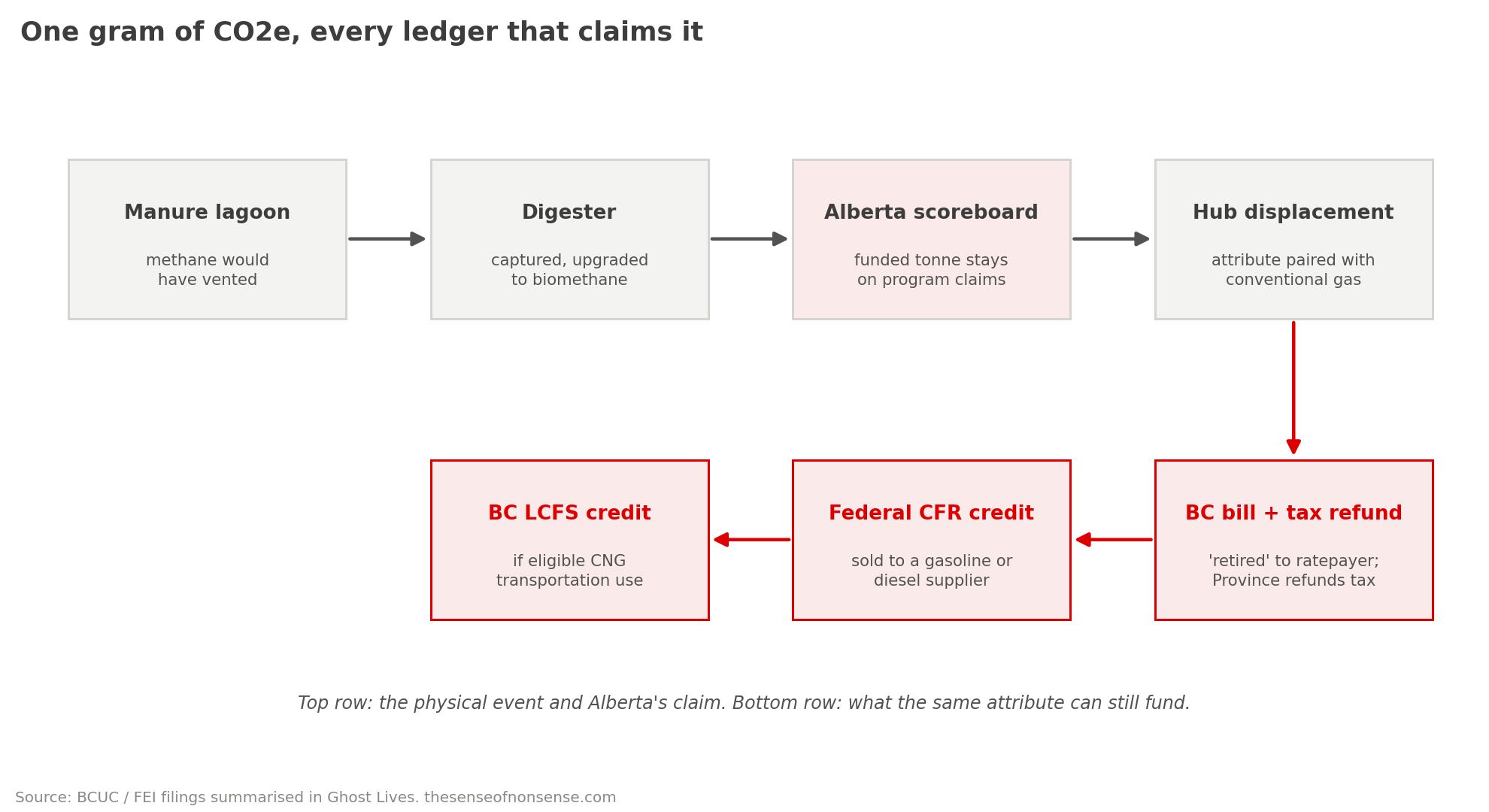
The route, before the detail. Top row is the physical event and Alberta’s claim. Bottom row is what the same attribute can still fund.
Start with a cow.
Not as metaphor. As feedstock.
Somewhere south of Calgary, or outside Lethbridge, or near Coaldale, manure goes into a lagoon. In the absence of a digester, anaerobic bacteria turn that organic carbon into methane. Methane is a short-lived but potent greenhouse gas. One gram of methane in the atmosphere does far more warming, over twenty years, than one gram of carbon dioxide. Capture that methane, upgrade it to pipeline-quality biomethane, and burn it as fuel, and you have changed the chemistry of the claim: the carbon in the methane was recently in the biosphere; the CO2 that comes out the burner is treated, in inventory practice, as biogenic rather than as new fossil carbon. The bigger climate win, on most lifecycle scores, is the methane that never left the lagoon as a fugitive emission.
That avoided gram of methane-equivalent, converted into CO2e on whatever global-warming-potential scale the program uses, is the physical event. Everything else in this article is paperwork about that event.
The paperwork multiplies.
Three grams, three systems, then the ghosts
Hold three stories side by side before combining them.
Gram A: inventory carbon. A gram of CO2 emitted from burning fossil gas in a Vancouver furnace shows up, in principle, in British Columbia’s provincial inventory and in Canada’s National Inventory Report under the IPCC territorial method. Location of combustion matters. Production emissions sit where production happened.
Gram B: Alberta program carbon. A gram of CO2e claimed under Alberta’s Technology Innovation and Emissions Reduction system, or under an Alberta Emission Offset Registry serial, or inside an Emissions Reduction Alberta portfolio megatonne, is a compliance or program object. It may be tied to a digester, a protocol, a verification report, a grant KPI. It lives in Alberta’s climate accounts and funding scorecards even when the transferable attribute has been sold away.
Gram C: Clean Fuel Regulations carbon. A gram of CO2e embodied in a CFR compliance credit is a lifecycle object. Primary suppliers of gasoline and diesel in Canada must lower the carbon intensity of their fuel pools. They can do that by changing their own fuel, or by buying credits created elsewhere, including credits from low-carbon gaseous fuels such as biomethane sold as fuel in Canada. One CFR credit represents one tonne of lifecycle CO2e reduction. The buyer of that credit is often a company still selling fossil liquid fuel.
Ghost lives begin when Gram A’s physics, Gram B’s program claim, and Gram C’s fuel credit are treated as if they were separate tonnes in the atmosphere.
They are not.
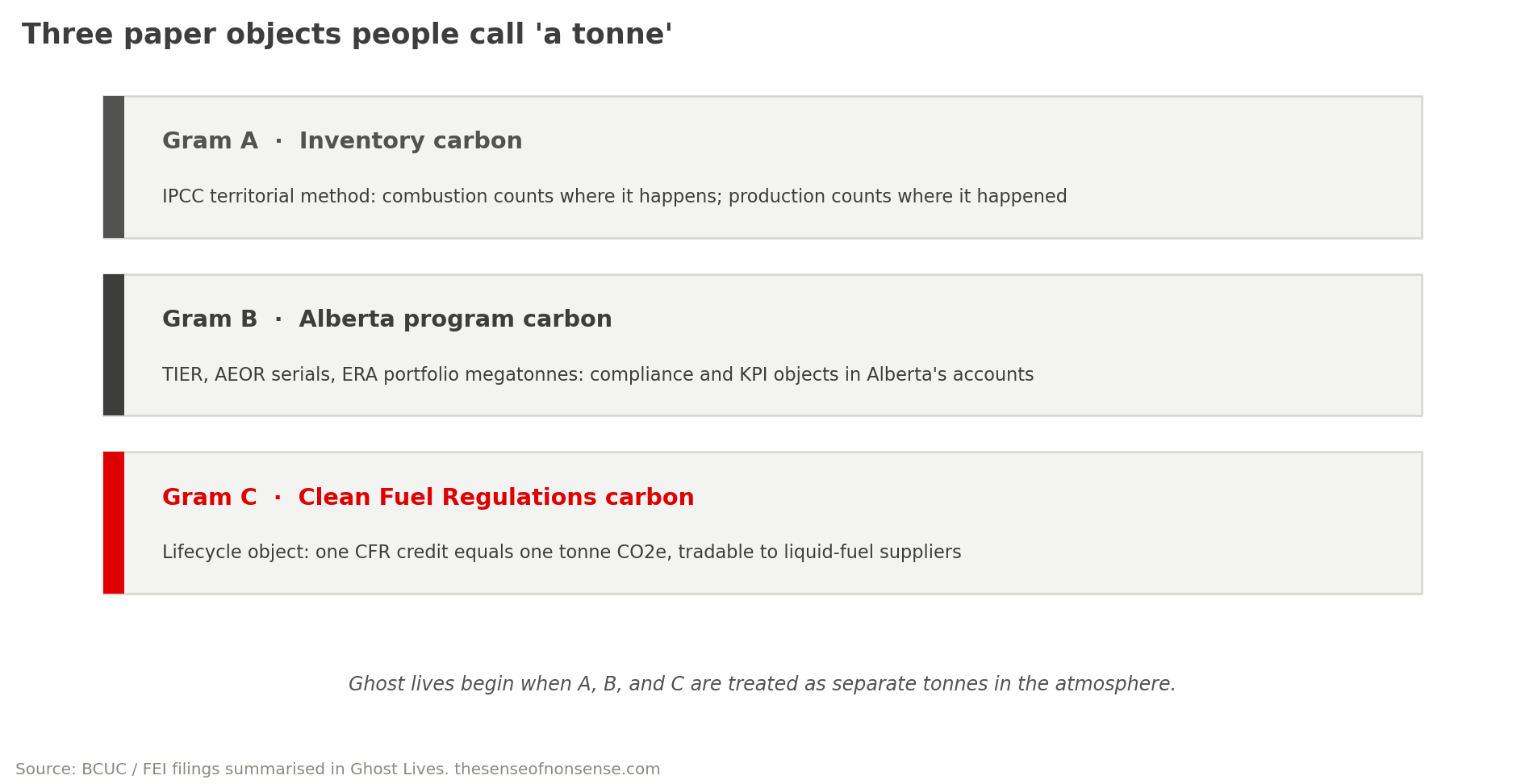
Three systems, three definitions, one atmosphere.
Life 1: the lagoon and the digester
Take a facility that already appears in both Alberta and BC records: Lethbridge Biogas, GrowTEC in Coaldale, Rimrock at High River. The pattern is documented in Paid in Alberta, Claimed Everywhere (TIER Files Part 5). Alberta’s industrial carbon funder, through ERA or its predecessor, put capital into the build. The Alberta Emission Offset Registry has carried, for some of these plants, Active or historically Active offset projects with serialized tonnes. ERA project pages and close-out reports speak in tonnes reduced and jobs supported.
At the molecular level, Life 1 is simple. Organic carbon that would have become fugitive methane is captured. Some of it becomes biomethane. Some of the climate benefit is methane avoidance; some is displacement of fossil gas when the biomethane is burned instead of geological methane. Verifiers argue about boundaries, baselines, and leakage. The atmosphere registers one set of fluxes.
Life 2: Alberta’s program claim (quasi-stacking)
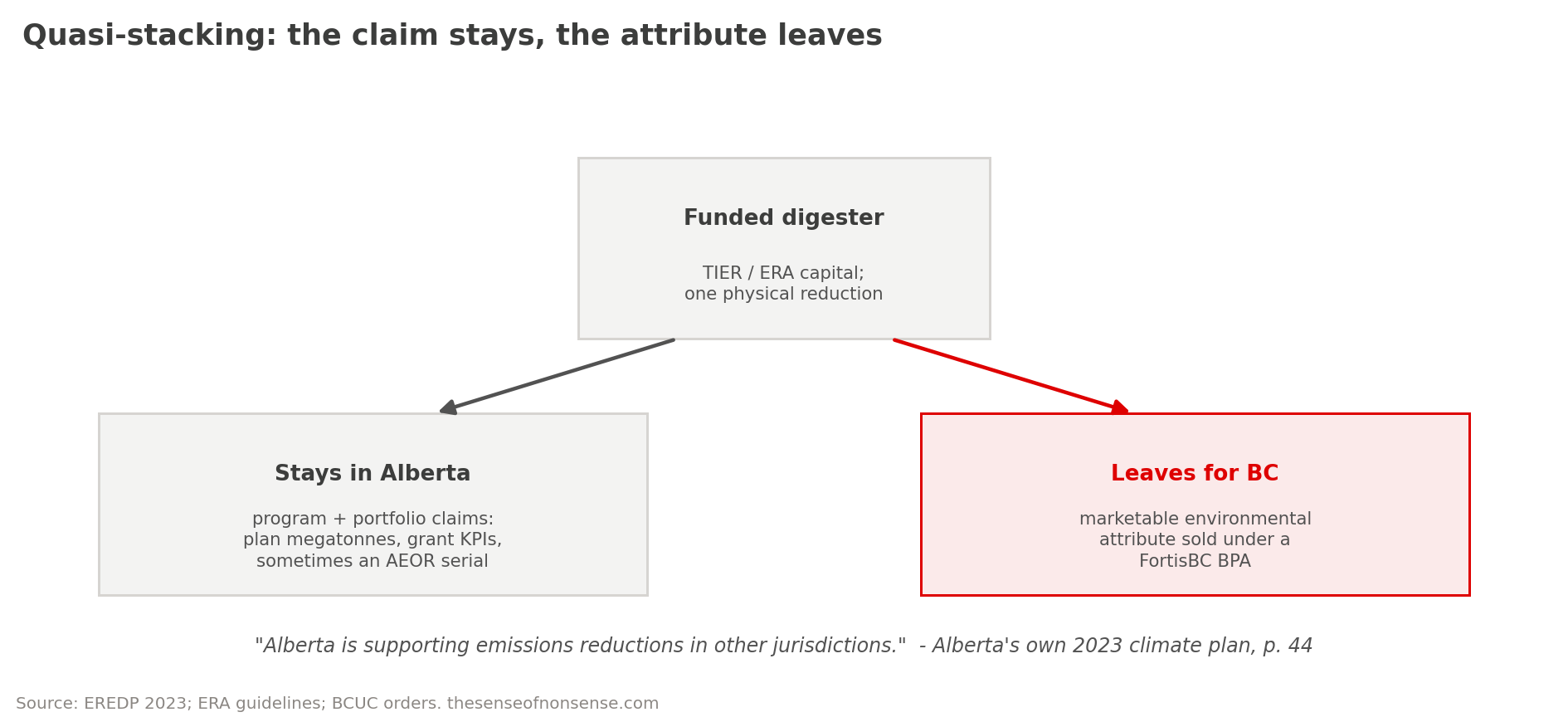
The scoreboard keeps a copy. The attribute leaves. The province wrote both halves down.
Alberta does something that is not always a formal stacked credit, and that is why “quasi” belongs in the sentence.
On some ERA incentive streams, the agency takes title to environmental attributes in the contribution agreement. On the demonstration-class digesters that later show up in FortisBC biomethane dockets, the public guidelines reviewed for Part 5 leave the transferable attributes with the project owner. Alberta’s 2023 Emissions Reduction and Energy Development Plan then says, on the record, that most RNG produced in Alberta is shipped to British Columbia for transportation and heating, and that Alberta is “supporting emissions reductions in other jurisdictions.” BioAlberta’s response paper adds that attributes used elsewhere do not serve Alberta’s own decarbonization ambitions.
At the same time, provincial and ERA materials continue to cite portfolio emission reductions and person-year jobs from funded projects, including bioenergy. The funded tonne stays on the scoreboard. The transferable attribute leaves.
That is quasi-stacking. Alberta is not necessarily issuing a second tradable offset on the same serial that FortisBC retires. It is keeping a program and policy claim on a reduction whose marketable environmental attribute has been sold into another jurisdiction’s machinery. Part 5 called this the double-claim problem that does not require matching a serial to a gigajoule. It requires only what the province already wrote: attributes leave, and funded reductions stay on Alberta’s accounts.
The funded tonne stays on Alberta’s scoreboard. The transferable attribute leaves. Both stories count the same gram.
From the gram’s point of view: Life 2 is a sentence in a plan, a line in a grant KPI, sometimes a registry serial that may or may not still be live for overlapping vintages. The gram has already done its atmospheric work. Alberta is still counting it toward Alberta’s story.
Life 3: British Columbia’s attribute purchase
FortisBC signs a Biomethane Purchase Agreement. For Alberta suppliers, the BCUC has accepted contracts under orders such as E-18-20 (Lethbridge), E-22-21 and E-20-23 (GrowTEC), E-22-22 (Rimrock), E-12-22 (Lacombe). Delivery is by displacement at a hub. The molecules burned in Lethbridge-area pipes are not the molecules burned in Kelowna. The attribute is what moved.
Under the GGRR, as amended in 2024, FortisBC must acquire and sell or transfer those attributes to customers and retire them at sale or transfer. Part 1 covered how that retirement is tracked: internal volume accounting in the RNG Account, not a public certificate.
The customer who pays the voluntary premium, and every customer who funds the mandatory blend, receives Life 3: a BC utility claim that this gigajoule was renewable. The Province may also grant a carbon-tax credit on that volume, which is Life 3b, a fiscal ghost riding the same attribute.
From the gram’s point of view: Life 3 is a book entry in Surrey and a line on a bill in Burnaby. The methane was captured in Alberta. The claim is consumed in British Columbia.
Life 4: federal Clean Fuel Regulations credit
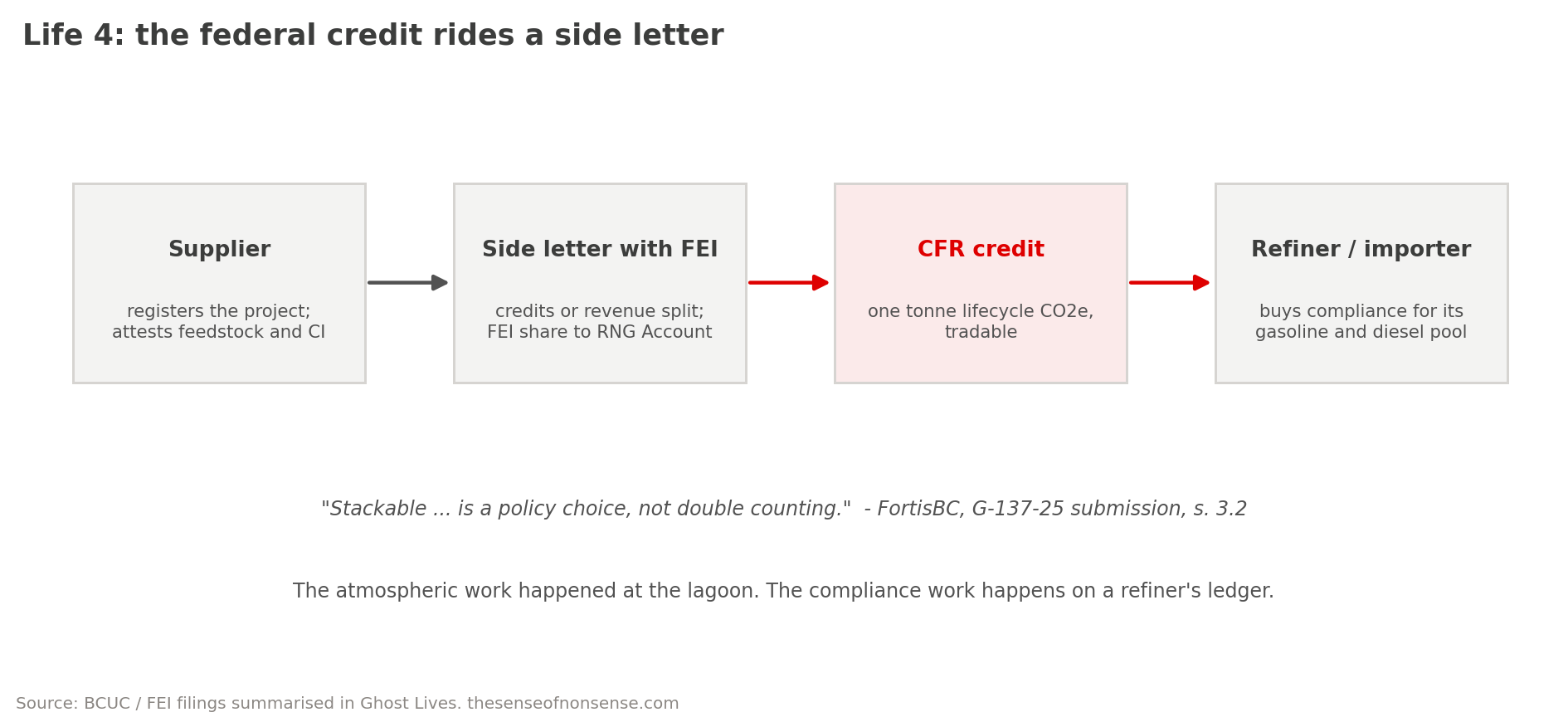
Sold to the liquid fuel pool, on FortisBC’s own description of the side letters.
Here the stack stops being quasi.
Environment and Climate Change Canada designed the Clean Fuel Regulations to complement other carbon policies. FortisBC’s G-137-25 submission states the design consequence without blushing: CFR credits are, in many instances, “stackable,” meaning parties “may be able to generate and monetize credits concurrently under multiple regulatory systems for the same underlying activity.” That, FEI says, “is a policy choice, not double counting.”
For biomethane, CFR credit creation typically requires cooperation between the fuel supplier and parties who can attest to feedstock and carbon intensity. FortisBC says it owns the environmental attributes under its BPAs, so suppliers cannot create CFR credits alone; FEI has negotiated side letters so that suppliers do the registration work and share the resulting credits or revenue with FEI “on behalf of its customers.” FEI’s share goes to the RNG Account. The supplier’s share stays with the supplier. Two 2024 attestation letters exclude CFR credits entirely from the supplier’s warranty package, which is how the Commission noticed the seam.
Who buys a CFR credit? A primary supplier of gasoline or diesel that needs to meet a declining carbon-intensity target for the liquid fuel pool. The credit lets that supplier avoid an equivalent reduction in its own fuel’s lifecycle intensity. The atmospheric work happened at the lagoon. The compliance work happens on a refiner’s ledger.
From the gram’s point of view: Life 4 is a compliance instrument sold into the liquid-fuel market. Same reduction. New buyer. New purpose.
Life 5: BC Low Carbon Fuel Standard credit
When renewable gas is used in compressed natural gas vehicles, FortisBC states that it has obtained BC LCFS credits for avoided emissions. In the same G-137-25 filing, FEI describes book-and-claim under the LCFS around BC-based RNG delivered to CNG stations. The Stage 2 record includes intervener evidence that out-of-province RNG faces physical-delivery hurdles for BC LCFS credit generation. So Life 5 is on the FortisBC file; it is not automatically available to every Alberta digester tonne that already supports Lives 2 through 4.
Where eligibility overlaps, BC’s low-carbon fuel rules and the federal CFR can both generate credits on low-CI fuel pathways. Whether both credits issue on the same volume is a boundaries-and-evidence question under each program.
Life 5 is another tradable credit, this time inside BC’s transportation fuel market, again often sold to an obligated fossil-fuel party.
Where does it end?
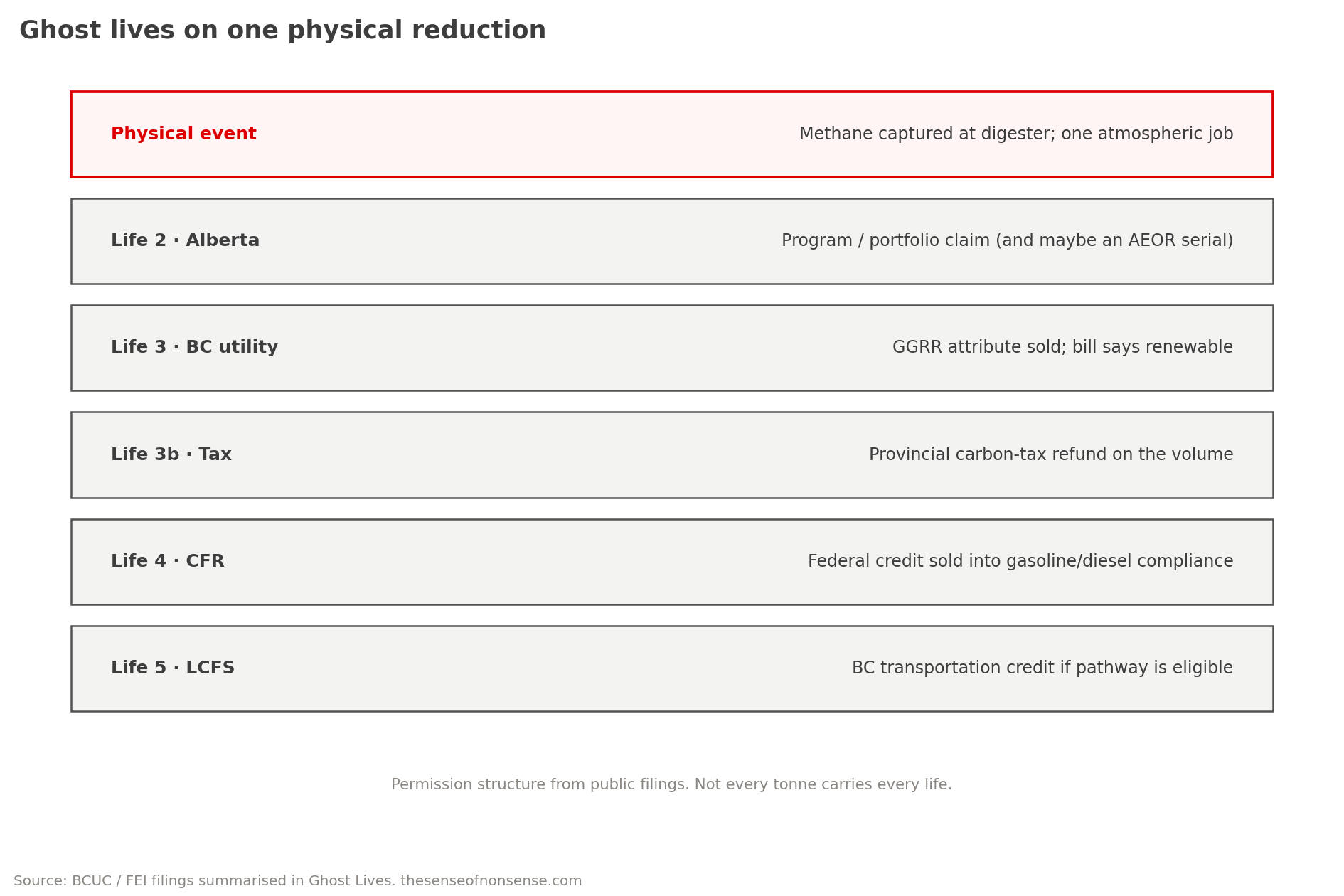
Permission structure from the public filings. Not every tonne carries every life.
Stacking ends where the paper runs out of markets, not where the atmosphere runs out of room.
A single avoided methane gram (expressed as CO2e) can, under the architectures described in public filings and regulations, support:
- an Alberta funding and portfolio claim,
- possibly an Alberta offset serial for some facilities and vintages,
- a FortisBC customer retirement under the GGRR,
- a BC carbon-tax refund on the sold volume,
- a federal CFR credit, and
- a BC LCFS credit if the end use is transportation and the pathway is eligible (FEI’s own filing frames LCFS book-and-claim around BC-based RNG).
Not every gram carries every life. Contracts, attestations, and eligibility rules chop the stack. The point is the permission structure. Alberta’s plan admits attribute export while keeping program claims. BC’s utility sells the attribute to ratepayers and, on its own Commission evidence, monetizes related federal credits. The federal fuel rule was built to stack. The registry that would let a citizen see which lives still attach to which gram does not yet exist in publishable form.
So where does stacking end? At the last program willing to treat the same reduction as incremental for its own purposes. Today that willingness runs at least from Edmonton’s grant scoreboard through Victoria’s carbon tax and CleanBC framing to Ottawa’s fuel-credit market, with a retail premium in the middle.
Molecular walkthrough (one tonne, simplified)
Walk one tonne of CO2e, not one gram, so the arithmetic matches how credits are denominated. The proportions are illustrative; real projects differ by feedstock, baseline, and verification.
- Physical event. Digester capture avoids the equivalent of one tonne CO2e of methane that would have vented from a manure lagoon, net of project emissions, as scored under a given protocol.
- Alberta Life. ERA announces a funded project contributing to portfolio reductions. The provincial plan may still count bioenergy progress. An AEOR serial may or may not be issued for overlapping periods. The transferable biomethane attribute is sold under a FortisBC BPA.
- Displacement. One tonne CO2e of attributes is paired with conventional gas at AECO/NIT and sold into FortisBC’s inventory.
- BC customer Life. FortisBC sells that tonne (as gigajoules) into the blend or voluntary program. Internal accounts mark the attribute retired. A Vancouver household’s bill shows a renewable share. The Province refunds carbon tax on that share.
- CFR Life. Through a side letter, a CFR credit (or a share of credits) is created for biomethane placed as fuel in Canada. A gasoline importer buys the credit and retires it against its CFR obligation. That importer sells the same volume of liquid fuel it would have sold, with a lower compliance burden.
- LCFS Life (if eligible CNG). If a trucking fleet burns eligible renewable gas, a BC LCFS credit may also issue and trade. FEI’s G-137-25 materials describe that pathway for BC-based RNG; out-of-province eligibility is narrower on the Stage 2 record.
Atmosphere: one tonne of avoided warming impact (subject to all the usual lifecycle caveats). Ledgers: up to half a dozen entries that each look, locally, like a tonne of progress.
What stacking is, and what it is not
Stacking, in the CFR sense FortisBC cites, is a deliberate policy choice to let one project earn revenue from multiple instruments so that low-carbon investments clear a private hurdle rate. ECCC’s quantification guidance has long contemplated projects that also interact with provincial carbon pricing. Complementarity is the official word.
Stacking is not the same as proving additionality to every buyer. A ratepayer paying an $8.66/GJ premium is usually sold a story of personal climate benefit. A CFR credit buyer is buying compliance. A provincial plan is buying a narrative of climate policy success. When those stories share one physical tonne without a public reconciliation, each story can be locally true and jointly inflated.
Quasi-stacking, as used here, is Alberta’s version: keep the funded reduction on the provincial and agency scoreboard after the marketable attribute has left. No second CFR-style credit is required for the inflation to appear. The scoreboard and the export are enough.
Concession
Pipelines mix molecules. Inventories follow territories. Fuel rules follow lifecycle models. Program KPIs follow grant agreements. These systems were not designed by one committee, and stitching them with book-and-claim was a rational response to physical reality. Stacking can make a digester financeable that would not have been built on one revenue stream alone. Some of those digesters reduce real methane. Federal-provincial complementarity is written into CFR materials for a reason.
The concession does not erase the ghost lives. It explains why they were invited in.
Finding
Follow the gram and the story is shorter than the regulations.
Methane is captured once. Alberta can still claim the funded project. British Columbia can still sell the attribute to every ratepayer and refund carbon tax on it. Ottawa’s fuel rule can still turn a related credit into compliance for a liquid-fuel supplier. BC’s LCFS can still do the same in transportation where the pathway qualifies. FortisBC calls the federal piece stackable and returns a share of proceeds to rates. Alberta’s own plan admits the attributes leave.
Where stacking ends is not a law of physics. It is a choice about whether uniqueness is required before a tonne may be sold, booked, refunded, and credited again. The public file, from Edmonton through the BCUC docket to the CFR credit market, still does not publish a single ledger that would let a reader watch one gram retire from every life at once.
Until that ledger exists, the molecule will keep doing one job while the paper assigns it several.
G-137-25 is still open. When the Commission answers its own double-counting question, I will read the answer here.
If I have misread a regulation, a filing, or a plan, the documents are linked below; show me and I will correct it.
Sources
- Government of Alberta, Emissions Reduction and Energy Development Plan (2023), Part Five (bioenergy), p. 44: RNG shipped to British Columbia; Alberta supporting reductions in other jurisdictions. open.alberta.ca PDF
- BioAlberta, Bioenergy Position Paper (2023): attributes used elsewhere do not benefit Alberta’s decarbonization ambitions. bioalberta.com PDF
- Lars J. Frank, “Paid in Alberta, Claimed Everywhere,” The TIER Files Part 5: ERA funding, AEOR listings, FortisBC BPA table, attribute-retention contrast across ERA programs. series link
- BCUC Orders E-18-20, E-22-21, E-20-23, E-22-22, E-12-22: FortisBC biomethane purchase agreements with Alberta suppliers (Lethbridge, GrowTEC, Rimrock, Lacombe), as summarised in FEI’s G-137-25 materials.
- FortisBC Energy Inc., G-137-25 Appendix B Submission (Exhibit C1-2), s. 3.2: CFR credits “stackable”; side letters; revenue split; attestation exclusions. FEI PDF
- FortisBC Energy Inc., Response to BCUC IR No. 1: BC LCFS participation and credits for RNG in CNG vehicles; inventory and book-and-claim discussion. FEI PDF
- Greenhouse Gas Reduction (Clean Energy) Regulation (as amended July 2024): environmental attribute definition; retirement at customer sale or transfer.
- Clean Fuel Regulations (SOR/2022-140) and ECCC compliance overview: credit = one tonne lifecycle CO2e; complementarity with other climate policies; credit market. canada.ca
- ECCC, Clean Fuel Regulations Quantification Method Development Guidance Document: projects overlapping provincial carbon pricing remain eligible for CFR credit creation where QM criteria are met. publications.gc.ca PDF
- ECCC, Generic Quantification Method materials: book-and-claim accounting for RNG among listed methods. canada.ca
- BCUC Order G-137-25 and proceeding record: cross-border double-counting questions. proceeding 1355
- Ghost Lives Part 1, “What the Premium Buys”: FortisBC premium, mandatory blend, carbon-tax refund, five-claim architecture on the BC side.
- FEI Shell BPA additional evidence (2021): book-and-claim / displacement delivery description for out-of-province RNG. FEI PDF
- Province of British Columbia, Provincial Inventory methodology (2023 inventory published 2025): NIR-based territorial accounting; renewable fuel adjustments in transport lines. gov.bc.ca PDF