
Part 1 of Ghost Lives, a series that follows a methane reduction from the digester into every ledger that claims it.
Everything here comes from BCUC orders, FortisBC Energy Inc. filings in the renewable gas proceedings, the Greenhouse Gas Reduction (Clean Energy) Regulation, and related public records. Sources, with page and exhibit references, are at the bottom.
If you pay FortisBC for renewable natural gas, the company tells you a simple story. You designate a blend. You pay a premium. You get a lower-carbon claim for the gas you burn.
The story is not false. It is incomplete.
On 5 June 2025 the British Columbia Utilities Commission opened Order G-137-25, an inquiry into how renewable natural gas is defined and how out-of-province environmental attributes are accounted for. The Commission asked, in plain language, whether existing rules stop double counting across jurisdictions. FortisBC Energy Inc. answered at length. Inside that answer sits a section titled, without irony, “Creating Credits Under the CFR is not Double Counting.”
You can see it from that section title alone. A utility that has to explain why monetizing federal Clean Fuel Regulations credits from the same renewable gas it sells to premium customers is not double counting is already living inside the architecture this series is about.
I wanted to check the claim against the public file, the same way Part 5 of The TIER Files checked Alberta’s digesters against the BCUC biomethane docket. This instalment stays on the BC side: the Commission, the utility, the premium, the mandatory blend, the carbon-tax refund, and the credit markets FortisBC itself describes. Part 2 follows the same reduction back into Alberta and forward into the federal fuel rules.
What a customer buys
FortisBC’s renewable gas program, formerly the Biomethane Program, was first approved by the BCUC in 2010. Costs are recovered through a charge paid by voluntary customers and through mechanisms that spread remaining costs across the rate base.
Voluntary customers can designate five, ten, twenty-five, fifty, or one hundred per cent of their gas use as renewable. Through the Stage 2 review decided in Order G-77-24, the Commission approved a subsidised voluntary rate for non-NGV sales customers at a $7 per gigajoule premium above conventional natural gas. FortisBC’s own cost page later shows the biomethane charge rising to $8.660 per GJ as of 1 April 2026. Check the current tariff before quoting either figure in print; the marketing page and the ordered methodology are different instruments, and both move.
The mandatory floor has been climbing. FortisBC put the designated blend at one per cent on 1 July 2024, three per cent on 1 July 2025, and 3.5 per cent on 1 July 2026 for all gas customers, whether they volunteered or not. The voluntary program continues on top of that floor. A customer who designates five per cent today is buying 1.5 per cent of voluntary renewable gas and 3.5 per cent of the automatic designation.
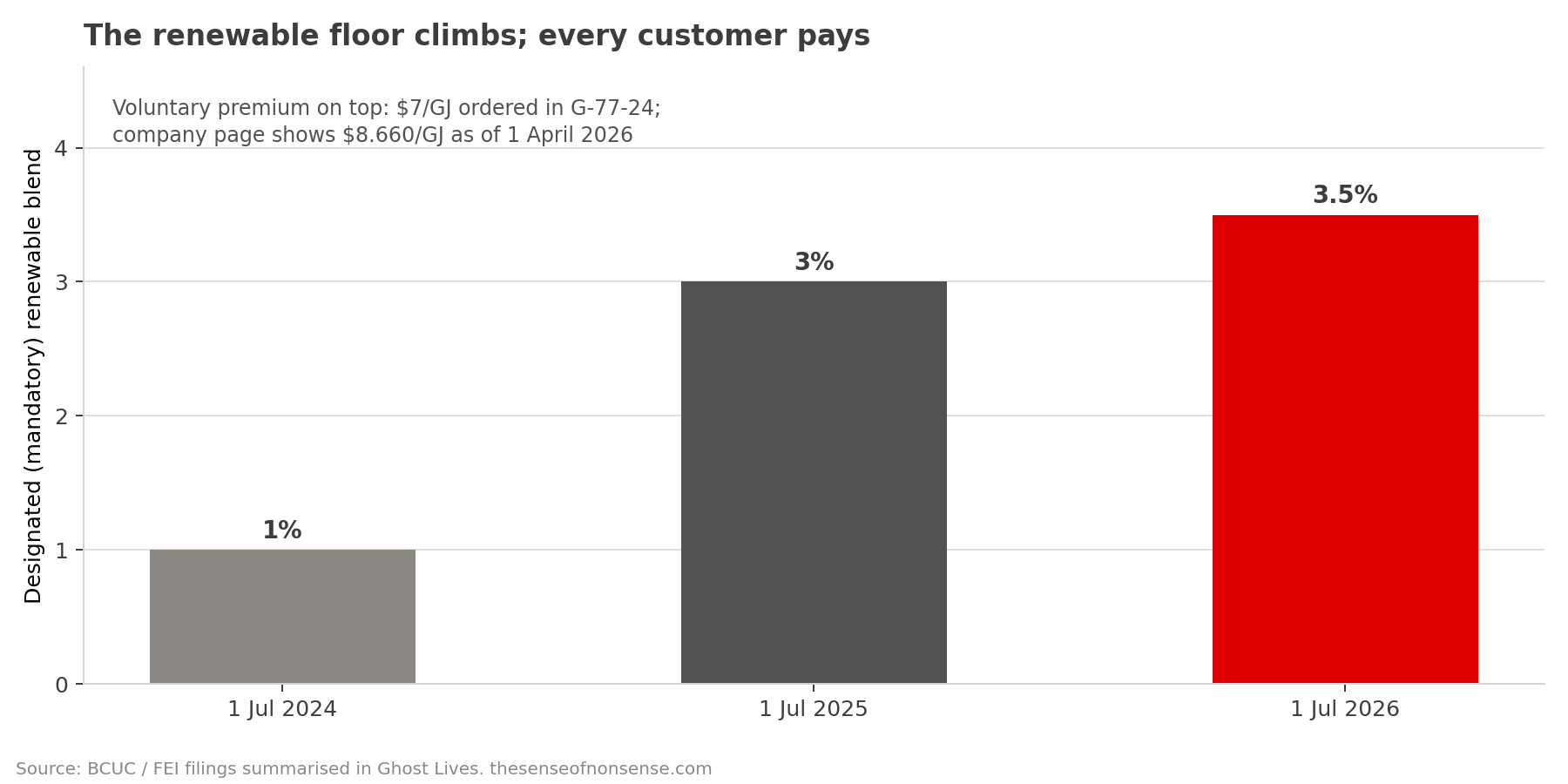
The floor under every bill, from the company’s own cost page. The premium rides on top.
So the premium is no longer a niche product for green households. Every ratepayer funds renewable gas acquisition. Voluntary customers pay more. The Commission has repeatedly accepted that structure under the Greenhouse Gas Reduction (Clean Energy) Regulation, which makes qualifying renewable gas acquisition a “prescribed undertaking.” Under section 18 of the Clean Energy Act, the Commission must set rates that let the utility recover prescribed-undertaking costs and must not exercise its powers in a way that prevents the undertaking.
That legal frame matters. Once a contract qualifies as a prescribed undertaking, the Commission’s public-interest review is constrained. The Shell biomethane purchase agreement for Iowa supply, accepted under Order E-14-21 and related reasons, is the textbook case: out-of-province biomethane, notional delivery, accepted as a prescribed undertaking.
What arrives in the pipe
Most of the contracted volume is from outside British Columbia. In Stage 2 IR responses to Creative Energy, FortisBC confirmed that the majority of expected annual volume for both existing and anticipated contracted RNG projects is sourced outside the province. Delivery is by displacement rather than as a tagged molecule that travels west. (An intervener later put the out-of-province share above seventy per cent in a question to FortisBC; FortisBC corrected other premises in that exchange and did not publish its own percentage there.) The supplier injects biomethane into a local system somewhere else. Nearby customers burn those molecules as ordinary gas. At a trading hub (AECO/NIT, Huntingdon, Station 2), an equivalent volume of conventional gas is paired with the environmental attributes and sold to FortisBC as “renewable natural gas.”
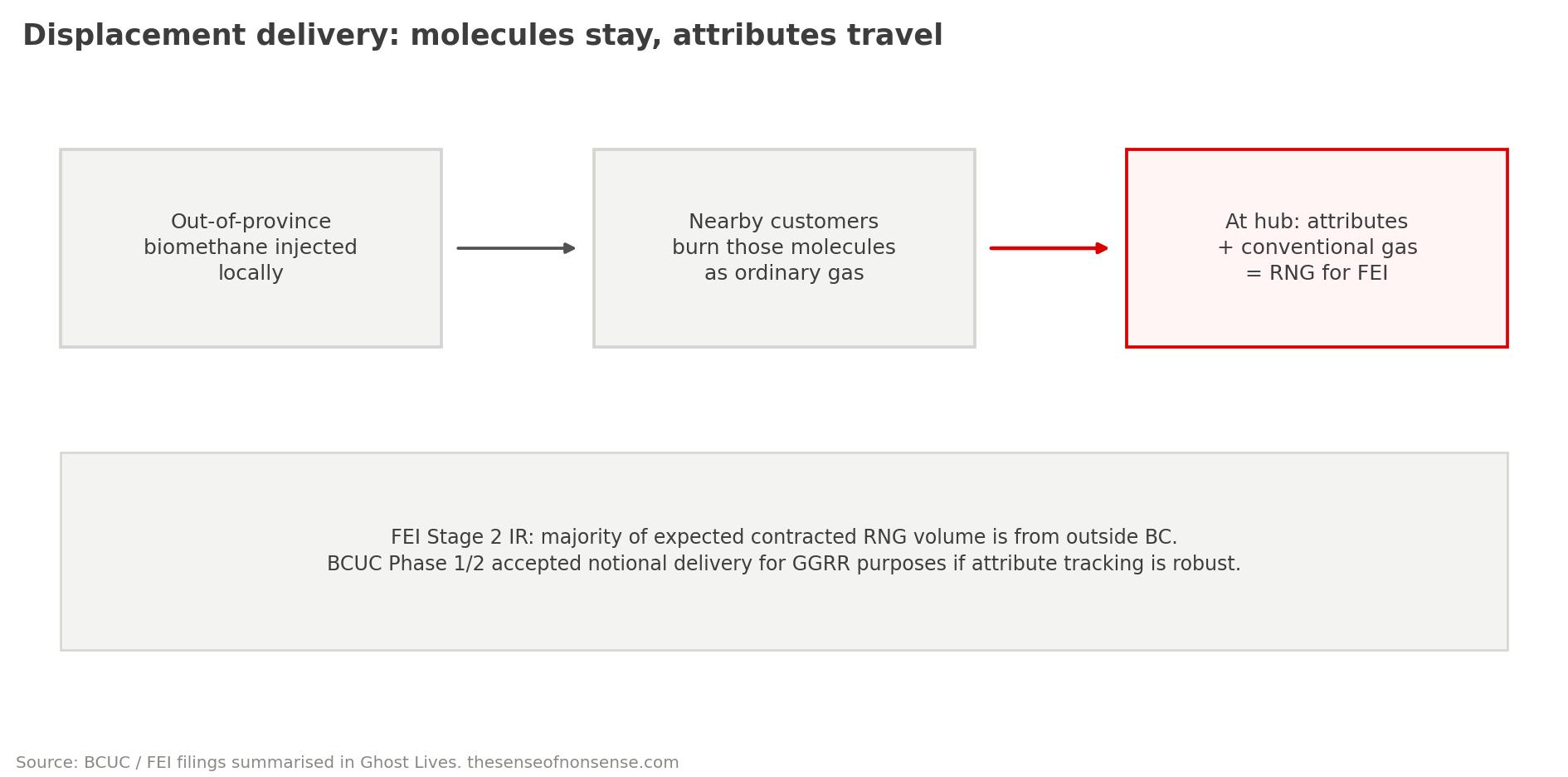
Book-and-claim in one picture. The paper moves. The methane usually does not.
The BCUC’s Phase 1 and Phase 2 RNG Inquiry reports (2022 and 2023) accepted that structure for GGRR purposes: biomethane with its attributes, or conventional gas plus transferable attributes from biomethane produced elsewhere, both count as acquiring RNG. Phase 2 also confirmed notional delivery as appropriate if attribute tracking is robust.
G-137-25 reopened the tracking question. The Commission asked whether existing compliance requirements protect against double counting of environmental attributes in BC and in other jurisdictions, and whether, when fossil gas with an attached out-of-province attribute is burned in BC, the emissions associated with that fossil gas are added back into the other jurisdiction’s inventory.
FortisBC’s answer, in short: inventories are territorial; biogenic CO2 from RNG combustion should not be double-counted as if it were fossil; contractual warranties, audits, and market scans show no evidence of supplier double counting; and the federal Clean Fuel Regulations are a separate, stackable market.
That last clause is the one that opens the door.
Five claims on one reduction
From FortisBC’s own filings, a single acquired reduction can carry, at the same time, multiple monetizable or reportable claims. Not every gigajoule carries every claim. The architecture permits the stack.
The same gigajoule can charge a premium, earn a carbon-tax refund, and back a federal fuel credit, all on FortisBC’s own filings.
Claim 1: the voluntary premium. The customer pays $7 to $8.66/GJ above conventional gas and is told the environmental attributes attach to their consumption.
Claim 2: the mandatory blend. Every sales customer funds a share of renewable gas costs through rate mechanisms approved in the Stage 2 review (including the S&T LC / RNG rider structure). As of July 2026 that share is framed as a 3.5 per cent designation.
Claim 3: the provincial carbon-tax refund. When biomethane is sold to customers, FortisBC’s Stage 2 record describes carbon tax credits granted to customers and refunds claimed from the Province. The G-77-24 decision notes that FortisBC must sell biomethane in the month it is blended to receive the provincial refund. The reduction therefore triggers a public fiscal benefit (foregone carbon tax) as well as a private premium.
Claim 4: federal Clean Fuel Regulations credits. In its G-137-25 submission, FortisBC states that compliance credits under the CFR are designed to be “stackable” with other policies: parties “may be able to generate and monetize credits concurrently under multiple regulatory systems for the same underlying activity.” FortisBC has negotiated “side letters” to existing biomethane purchase agreements so that suppliers help create CFR credits. “A portion of any CFR credits generated or revenue from the sale of such CFR credits is allocated to the RNG supplier and a portion is allocated to FEI on behalf of its customers.” FEI says it will put its share of proceeds into the RNG Account to reduce rates.
Two of the supplier attestation letters filed with FortisBC’s 2024 BPA Annual Compliance Report exclude CFR credits. The Commission flagged those exclusions. FortisBC’s explanation is that the exclusions reflect registration mechanics under the CFR, not a transfer of environmental attributes away from FEI, and that FEI still owns the attributes under the BPA. Read carefully: the utility is describing a world in which the attribute is “retired” for the GGRR customer sale while a related federal compliance credit is still being created and sold.
Claim 5: BC Low Carbon Fuel Standard credits. In its response to BCUC Information Request No. 1 in the same inquiry, FortisBC states that it “participates in the BC LCFS and has obtained credits for avoided emissions for the use of RNG in CNG vehicles.” In the same G-137-25 submission, FEI frames book-and-claim under the LCFS around BC-based RNG delivered to CNG stations. The Stage 2 record also carries intervener evidence that out-of-province RNG faces physical-delivery hurdles for BC LCFS credit generation. So Claim 5 is real on the FortisBC file; it is the claim least automatically available to an Alberta digester tonne.
Five paper objects. One methane reduction at the digester. Not every object lands on every tonne.
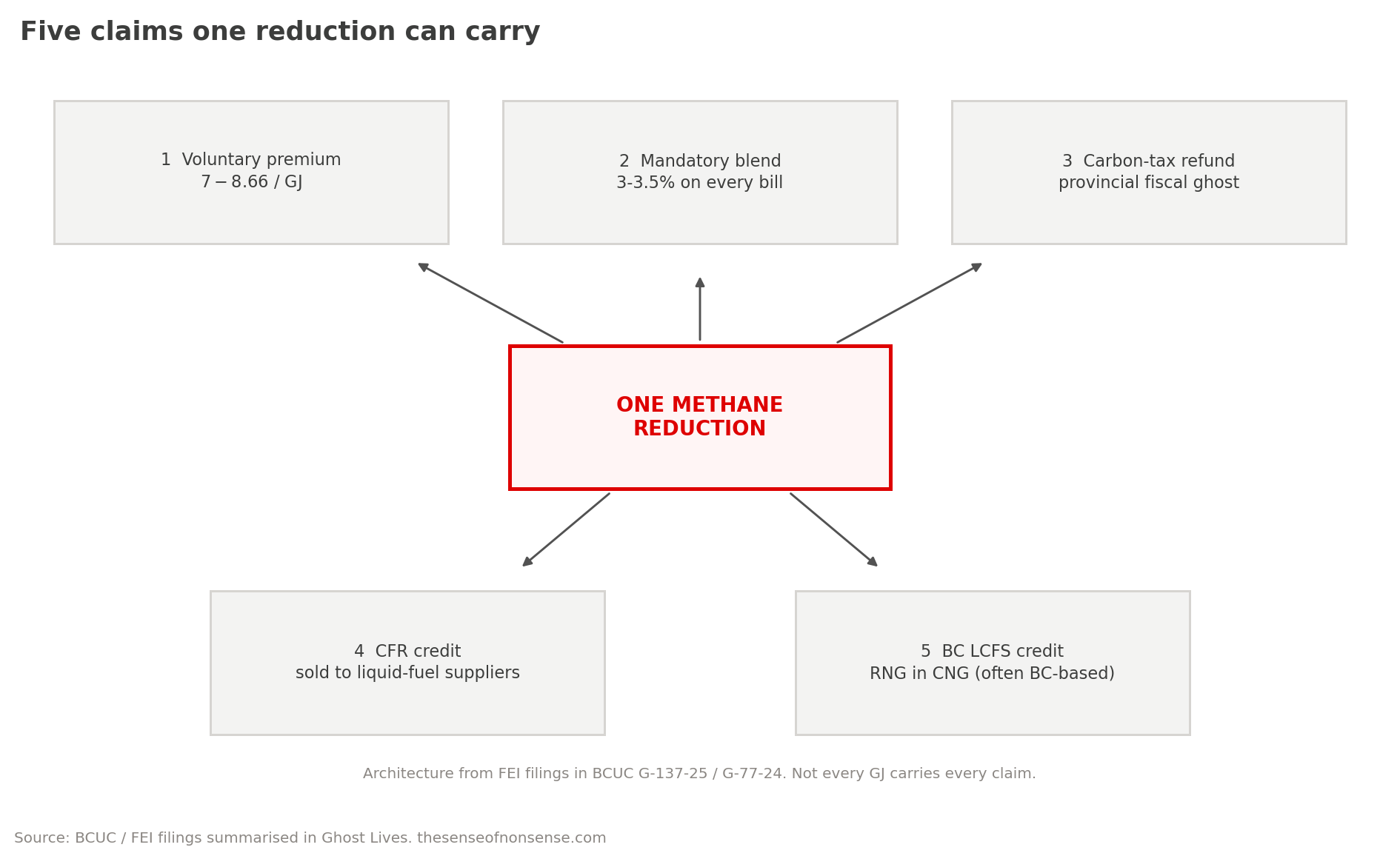
The architecture, not a claim that every gigajoule hits every market.
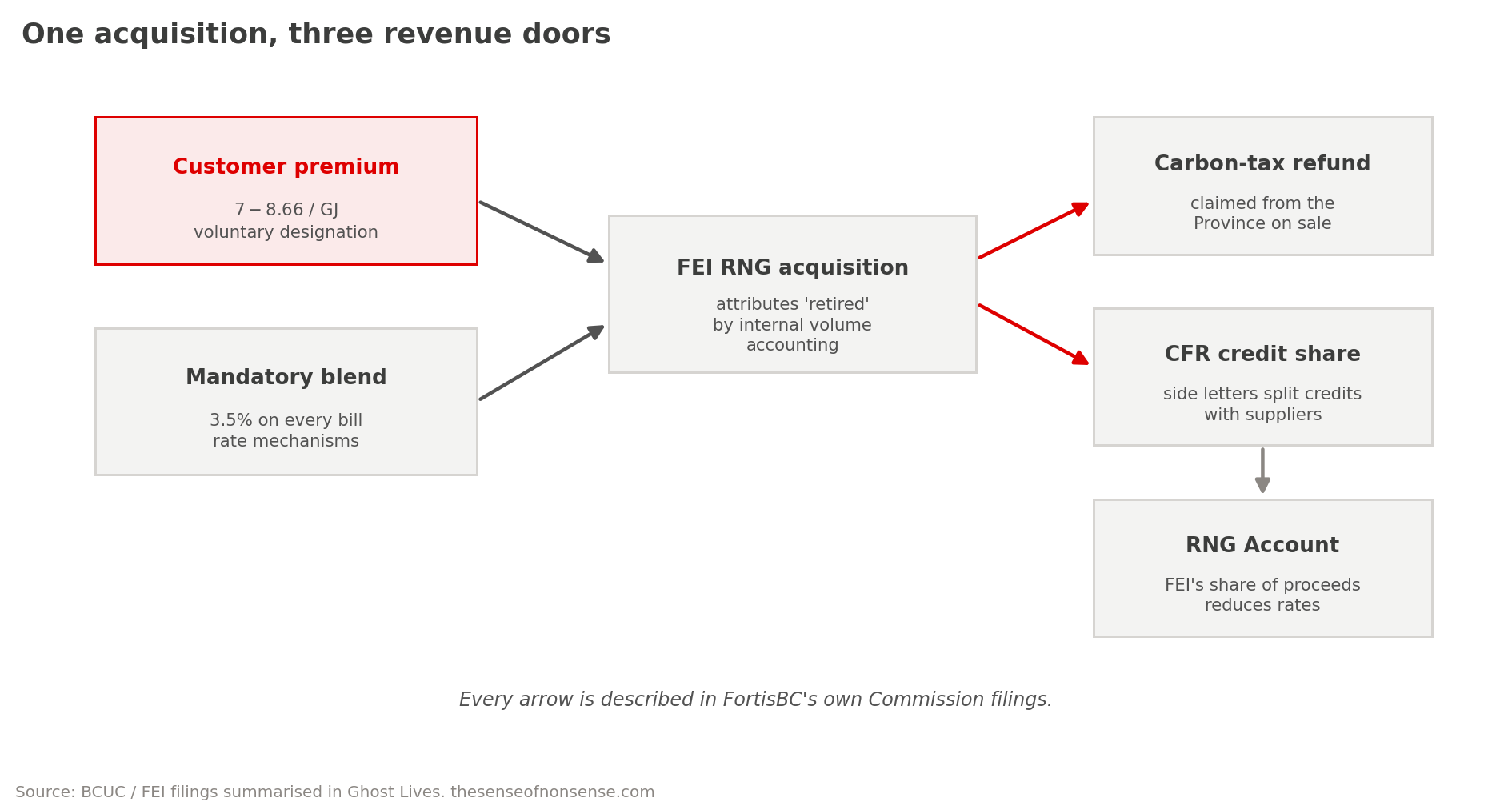
What the bill thinks it bought, and what else the same acquisition can fund. Every arrow is in the filings.
How “retirement” works without a certificate
The July 2024 GGRR amendments require that, for acquisitions after that date, the public utility acquires and sells or transfers the environmental attributes to its customers, and that those attributes “are retired at the time of sale or transfer to the customers of the public utility.”
FortisBC tells the Commission it does not receive environmental certificates that can be retired in association with its RNG purchases. It tracks volumes purchased, sold, and held in inventory in the RNG Account (formerly the Biomethane Variance Account), filed annually with the Commission. Consumption by the end customer, on that internal continuity report, constitutes retirement.
That may satisfy the Regulation’s wording. It does not give a citizen a serial number. There is no public registry, yet, that would let a Vancouver ratepayer match the gigajoules on their bill to an unsold-elsewhere tonne at a Lethbridge digester. FortisBC says industry and government are working on a Canadian registry (CLEER and related workstreams appear in the IR record). Until that exists, retirement is an accounting entry inside the utility, overseen through Commission filings, not a publicly inspectable certificate cancellation.
Retirement is an accounting entry inside the utility, not a certificate a citizen can check.
What the Commission is actually asking
G-137-25 is not a prosecution. It is a definition and accounting inquiry. The questions go to the intent of the GGRR, the adequacy of compliance requirements against cross-border double counting, and whether further out-of-province acquisitions remain consistent with the Regulation.
Interveners include Stand.earth, BC Sustainable Energy Association, My Sea to Sky, First Things First Okanagan, Force of Nature Alliance, MoveUP, Metro Vancouver, the Commercial Energy Consumers, Creative Energy, Pacific Northern Gas, CleanCounts, the Canadian Biogas Association, and the Coalition for Renewable Natural Gas. Stand.earth’s earlier letter helped trigger the original RNG Inquiry; its 2024 greenwashing lawsuit against FortisBC (filed with Ecojustice and Slater Vecchio) is a separate civil claim about advertising and is cited here only as context, not as adjudicated fact.
The Commission’s Phase 1 and Phase 2 reports already accepted out-of-province RNG under the GGRR. G-137-25 asks whether the accounting around those attributes is good enough. FortisBC’s answer is that contracts, audits, and scans are good enough, and that CFR monetisation is a different market.
Concession
Displacement delivery and book-and-claim are ordinary North American practice. California’s LCFS uses related machinery. Molecules in a pipeline are fungible; attributes have to be tracked somehow. Prescribed undertakings under the Clean Energy Act are a provincial policy choice to force climate spending through the utility rate base. Stacking credits across federal and provincial fuel programs is, on FortisBC’s reading and on Environment and Climate Change Canada’s complementarity language, intentional design meant to improve project economics.
A digester that keeps manure methane out of the air does real atmospheric work. None of that is invented for this series.
Finding
The finding does not require proving fraud. It requires reading FortisBC’s own Commission filings.
A customer who pays the renewable gas premium is buying a claim that FortisBC says is retired on consumption. The same acquisition architecture, on those same filings, can also trigger a provincial carbon-tax refund, generate a federal CFR credit sold to a primary supplier of gasoline or diesel, and, for transportation use of eligible RNG, generate a BC LCFS credit. FortisBC has confirmed that a majority of its expected contracted RNG volume is out-of-province paper attached to conventional gas. Retirement is tracked by internal volume accounting without a public certificate. Two supplier attestations already carve out CFR credits while the GGRR retirement story continues.
What the premium buys is a place in that stack. Whether it buys a unique tonne is a question the public file still cannot answer from the outside.
Next: where stacking ends.
If I have misread a filing or an order, the documents are linked below; show me and I will correct it.
Sources
- BCUC Order G-137-25 (5 June 2025), Review of Renewable Natural Gas Definition and Accounting: inquiry scope and double-counting questions. bcuc.com proceeding 1355; Lexum text
- FortisBC Energy Inc., Submission per G-137-25 Appendix B (Exhibit C1-2), especially s. 3.2 “Creating Credits Under the CFR is not Double Counting,” side-letter mechanics, and attestation-letter CFR exclusions. FEI PDF
- FortisBC Energy Inc., Response to BCUC IR No. 1 (Exhibit C1-3 / All IR1), chain-of-custody description and BC LCFS participation statement. FEI PDF
- BCUC Decision and Order G-77-24, FEI BERC Stage 2 / Revised Renewable Gas Program: $7/GJ voluntary premium, carbon-tax refund timing, rate recovery structure. BCUC PDF
- FortisBC, “How much does Renewable Natural Gas cost”: designated blend progression (1% from 1 July 2024; 3% from 1 July 2025; 3.5% from 1 July 2026); biomethane charge $8.660/GJ (1 April 2026) as published on the company page. fortisbc.com
- FEI Stage 2 Revised Renewable Gas Program, response to Creative Energy IR1: majority of expected annual volume for existing and anticipated contracted RNG projects sourced outside BC. FEI PDF. My Sea to Sky IR3 (displacement / inventorying; intervener “over 70%” premise left unconfirmed as a FEI figure): FEI PDF
- BCUC Decision and Order G-212-22, RNG Inquiry Phase 1; Phase 2 Final Report (13 June 2023): definition of RNG acquisition for GGRR purposes; notional delivery. Phase 1 PDF
- Greenhouse Gas Reduction (Clean Energy) Regulation, as amended July 2024: environmental attribute definition; retirement at sale or transfer to customers; volume and cost caps for prescribed undertakings.
- Clean Energy Act, s. 18: prescribed undertakings; Commission duty to allow cost recovery and not to prevent the undertaking.
- BCUC acceptance of FEI-Shell BPA (Iowa supply; displacement), Order E-14-21 and reasons: out-of-country RNG as prescribed undertaking. BCUC orders
- FortisBC news release (23 April 2019): RNG inclusion under BC Low Carbon Fuel Standard. newswire.ca
- Province of British Columbia, Renewable and Low Carbon Fuels / Low Carbon Fuel Standard overview. gov.bc.ca
- Cross-reference: Lars J. Frank, “Paid in Alberta, Claimed Everywhere,” The TIER Files Part 5: Alberta funding and attribute export into FortisBC biomethane dockets. thesenseofnonsense.com