
An essay from the ledger. Sources at the bottom.
If you read the name alone, Natural Resources Conservation Board, you picture a tribunal that weighs forests, reservoirs, and ski hills against the public interest. That work is real. The Board still does it. Four active natural-resource files were on its project list when I pulled the site in mid-2026 (Snake Lake Reservoir Expansion, Chin Reservoir Expansion, the East Central Irrigation Project, and Scott Pit), and its Springbank Off-Stream Reservoir decision from 2021 is a thick public-interest report of the old school: Decision NR 2021-01, Cabinet authorization, approval issued the same autumn.
I opened the audited financial statements anyway, because that is the hobby.
The Statement of Operations for the year ended March 31, 2025, splits the agency’s directly incurred expenses into two lines. Board reviews and hearings: $1,084,168. Regulating confined feeding operations: $4,824,262. Total: $5,908,430.
That is 18.4 per cent on the Board line and 81.6 per cent on confined feeding. Look back through the statements I could line up cleanly and the ratio barely moves. In 2023-24 it was 17.8 and 82.2. In 2022-23, 19.3 and 80.7. In 2019-20, 21.4 and 78.6. In 2015-16, 19.3 and 80.7. For the better part of a decade, about four of every five operating dollars go to the Agricultural Operation Practices Act side of the house: approvals, registrations, authorizations, inspections, compliance, and the science that sits underneath.
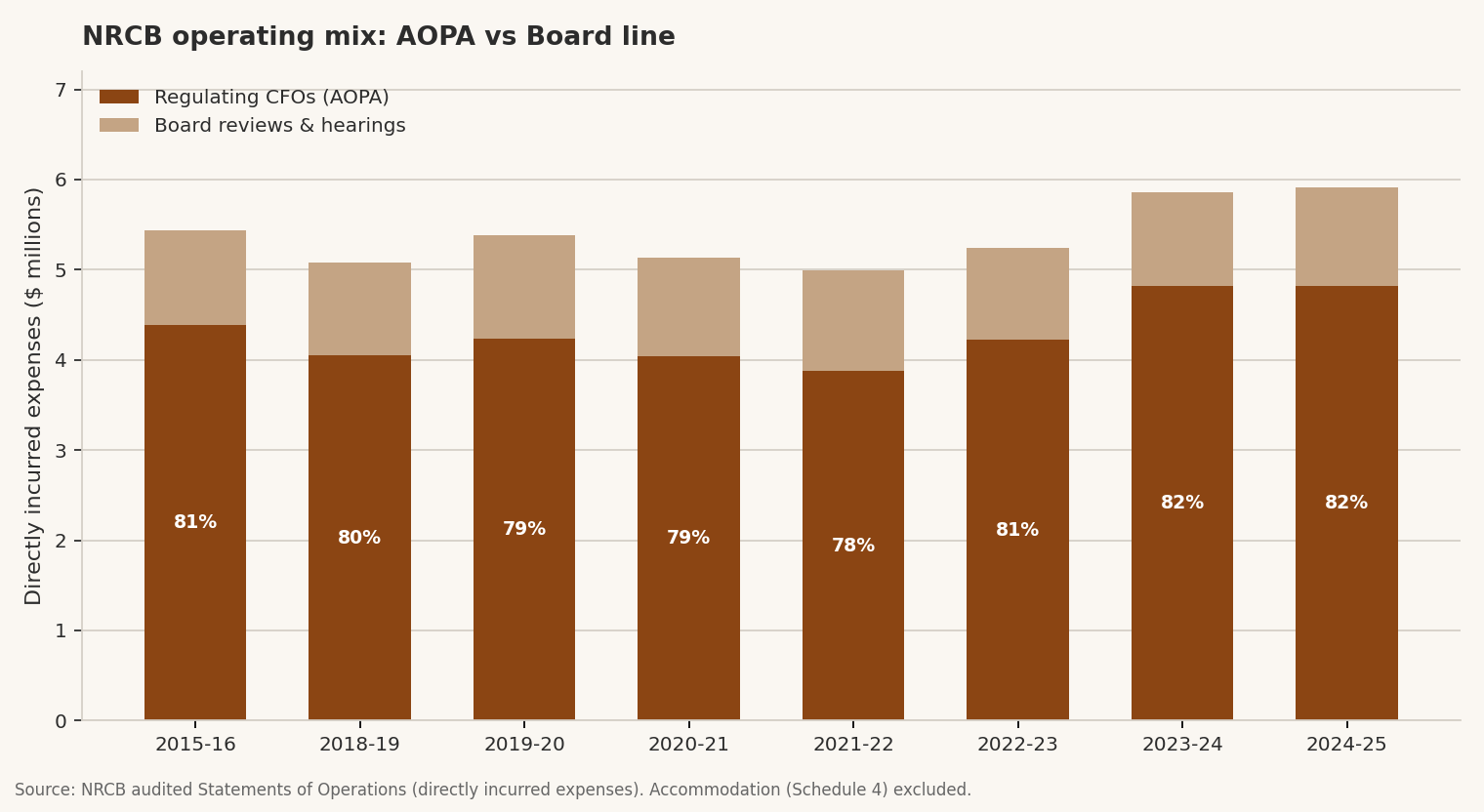
Directly incurred expenses from the audited Statements of Operations. Accommodation in Schedule 4 sits outside these totals.
Eighty cents of the dollar, give or take a couple of points depending on the year.
What the two lines actually buy
The footnotes, which are consistent across the recent reports, matter more than the labels. “Board reviews and hearings” covers AOPA appeals and Natural Resources Conservation Board Act (NRCBA) public-interest reviews, packed onto one program line. “Regulating confined feeding operations” covers AOPA approval, monitoring, and compliance, plus science and technical work that supports both AOPA and NRCBA.
So SciTech costs that help a reservoir review largely sit under the confined-feeding label. The Board line understates how much NRCBA-related technical effort the agency actually carries. The dual-mandate brand, for its part, overstates how much of the budget is classic public-interest tribunal work. Both readings come from the same footnotes: the accountants already said where the technical people park.
The NRCB reports to the Minister of Environment and Protected Areas. AOPA statute and regulations sit with Agriculture and Irrigation. A 2022 Mandate and Roles Document among NRCB, EPA, and AGI frames how the three talk to each other. On paper, the agency is a conservation board with a livestock-regulation job bolted on. On the Statement of Operations, the livestock job is the operating centre of gravity.
Where the money comes from
Revenue is simpler than the letterhead.
In 2024-25 the NRCB recognised $6,076,000 as a government transfer from Environment and Protected Areas, plus $104,608 of investment income and $3,412 of other revenue. Total revenue: $6,184,020. The transfer is the business. The Board collects it quarterly, and the statements treat liquidity as a non-issue for that reason.
Put the NRCB beside two better-known agencies on Alberta’s environment shelf and the design difference is the source line. The Alberta Energy Regulator funds itself largely through an industry levy on regulated entities. Emissions Reduction Alberta draws its grant engine from the TIER Fund architecture that this site has already walked through in audited detail. The NRCB draws Environment and Protected Areas general revenue. Same ministry neighbourhood, three funding designs.
There is a small institutional texture worth filing: the 2024-25 compensation notes say NRCB participates in the AER flexible health benefit plan. Shared services between agencies is ordinary government housekeeping. The note tells you the province sometimes routes back-office plumbing through the larger regulator.
Accommodation is the one large cost that never appears in the Statement of Operations total. Schedule 4 allocates space costs (including grants in lieu of taxes) by square footage, incurred by Infrastructure and booked as allocated costs. For 2024-25 that figure is $434,490, which lifts the all-in picture to about $6.34 million. Same pattern as other Alberta agencies that sit in government buildings and get the rent billed elsewhere. Roughly a seven per cent uplift on top of directly incurred expenses in recent years.
Salaries, wages, and employee benefits were $5,038,005 of the $5.9 million directly incurred. Supplies and services: $838,254. Amortization: $32,171. This is a people agency. Capital barely registers.
The cushion that can be called back
Then there is the surplus, which is the closest thing here to a float, and it behaves like appropriated money that can pool and can be recalled.
Accumulated surplus sat at $3,998,522 on March 31, 2020, the peak in the series I assembled. A year later it was $1,587,245. The notes explain the drop without drama: the budgeted transfer from the department was $5,397,000; an adjustment of $2,697,000 cut the actual transfer to $2,700,000. The agency posted a $2.41 million deficit for the year because the ministry took the cushion back.
Smaller call-backs show up too. The 2018-19 transfer originally booked at $6,433,000 had $1,300,000 returned to the department (disclosed in the 2019-20 comparative notes). In 2021-22 the Board returned $250,000 after an underspend. From 2022-23 through 2024-25 the annual surpluses rebuilt the balance: $231,316, then $259,101, then $275,590. By March 31, 2025, accumulated surplus had climbed to $2,516,559, with $2,657,025 of cash and cash equivalents on the statement of financial position.
The Business Plan 2024-27 still budgets small planned surpluses ($24,000 and $64,000 in the outer years shown), which is the planning assumption of an agency that expects to run near break-even after the transfer lands.
Readers who have followed the TIER Files know a float measured in hundreds of millions, fed by industrial carbon payments, and periodically swept toward general revenue or held as grant commitments. The NRCB’s cushion lives in the low millions. It answers to the ministry that writes the quarterly transfer. Same family of fiscal behaviour (money can sit; money can be called), different scale, different legal engine. Connection of theme is fair. Equating the two systems would overclaim.
One-liner for the notebook: general-revenue regulator with a callable cushion.
Who sits on top of it
Compensation disclosure for 2024-25 (Schedule 2) puts the Chair at $259,277 total cash and non-cash, and the chief executive officer at $252,547. Board Member B landed at $127,014; Board Member C at $123,424. The Chair position is disclosed as 80 per cent permanent part-time; the other Board seats at 60 per cent. No bonuses. Two individuals occupied the Chair and Member B seats across the December 2024 transition, which is why the disclosure reads a little crowded if you only glance at the totals.
Sandi Roberts became Chair in December 2024 after years as a Board member and, earlier, as an NRCB approval officer. Sean Royer is CEO. Peter Woloshyn, who had been CEO for roughly eleven years and then Chair for seven more, stepped down the same month. The Acting Board (Walter Ceroici, Earl Graham, Daniel Heaney, Darin Stepaniuk) sits ready for hearing work when the permanent Board needs the depth.
None of that tells you whether a particular feedlot decision was right. It tells you what kind of organization this is on the money side: a small regulator whose payroll and transfer dominate the page, whose conservation-board brand shares a budget line with AOPA appeals, and whose surplus lives at the pleasure of the department that funds it.
What this essay is for
I will stop before the requests-for-review statistics, the Springbank intervener cost awards, and the Policy Advisory Group seating chart. Those are the next ledgers, and each has its own audited or published trail.
For a first pass, the operating statements are enough. The NRCB’s public brand is a public-interest conservation board. The audited split shows confined feeding regulation as the main operating spend, paid from Environment and Protected Areas transfers, with a cash surplus that has been as high as about $4 million and as low as about $1.6 million after a ministry clawback. The dual-mandate tension is visible because the statements force the split. A program line is already an argument, of a quiet kind.
Eighty cents of the dollar buy confined feeding regulation paid from Environment and Protected Areas. The rest buys the Board line, which already folds AOPA appeals into the same column as the big project reviews. The name on the letterhead is longer than that. The Statement of Operations is exacting about it.
If I have misread a line item, the documents are linked below; show me and I will correct it.
Sources
-
Natural Resources Conservation Board, 2024-25 Annual Report, Statement of Operations; Schedule 1 (expenses by object: salaries $5,038,005; supplies $838,254; amortization $32,171); Schedule 2 (salary and benefits: Chair $259,277; CEO $252,547; Members B/C $127,014 and $123,424; AER health plan note; part-time fractions); Schedule 4 (allocated accommodation $434,490; total with accommodation $6,342,920); statement of financial position (cash $2,657,025; accumulated surplus $2,516,559); Notes on government transfers ($6,076,000), investment income ($104,608), other revenue ($3,412), annual surplus ($275,590). https://open.alberta.ca/publications/nrcb-annual-report and https://www.nrcb.ca/
-
Natural Resources Conservation Board, 2023-24 Annual Report, Statement of Operations (Board reviews $1,044,952; AOPA $4,817,164; total direct $5,862,116; shares 17.8% / 82.2%); Schedule 4 (accommodation $427,774); annual surplus $259,101; accumulated surplus end $2,240,969. https://www.nrcb.ca/
-
Natural Resources Conservation Board, 2022-23 Annual Report, Statement of Operations (Board $1,011,865; AOPA $4,228,210; shares 19.3% / 80.7%); Schedule 4 (accommodation $458,739); annual surplus $231,316; accumulated surplus end $1,981,868; clean OAG opinion. https://www.nrcb.ca/
-
Natural Resources Conservation Board, 2021-22 Annual Report, Statement of Operations (Board $1,113,376; AOPA $3,876,982; shares 22.3% / 77.7%); Note on $250,000 returned to Environment and Protected Areas; accumulated surplus end $1,750,552. https://open.alberta.ca/publications/nrcb-annual-report
-
Natural Resources Conservation Board, 2020-21 Annual Report, Statement of Operations; Note 4 (budgeted transfer $5,397,000; adjustment −$2,697,000; actual transfer $2,700,000; annual deficit $2,411,277; accumulated surplus end $1,587,245; Board/AOPA shares 21.2% / 78.8%). https://open.alberta.ca/publications/nrcb-annual-report
-
Natural Resources Conservation Board, 2019-20 Annual Report, Statement of Operations (Board $1,152,655; AOPA $4,235,107; shares 21.4% / 78.6%); accumulated surplus end $3,998,522 (series peak); Note 4 comparative (2018-19 original transfer $6,433,000 with $1,300,000 returned); accommodation $429,134. https://open.alberta.ca/publications/nrcb-annual-report
-
Natural Resources Conservation Board, 2018-19 figures as comparative in later reports and series table (Board $1,034,099; AOPA $4,049,863; shares 20.3% / 79.7%; accommodation comparative ~$480,257). https://open.alberta.ca/publications/nrcb-annual-report
-
Natural Resources Conservation Board, 2015-16 Annual Report, Statement of Operations (Board $1,048,129; AOPA $4,387,234; shares 19.3% / 80.7%; accumulated surplus end $3,395,101). https://open.alberta.ca/publications/nrcb-annual-report
-
Natural Resources Conservation Board, Business Plan 2024-27 (budgeted Board / AOPA expense split; government transfer revenue; planned surpluses $24,000 / $64,000 in outer years). https://www.nrcb.ca/
-
Natural Resources Conservation Board, natural resource projects listing (active NRCBA files including Snake Lake, Chin Reservoir, East Central Irrigation Project, Scott Pit; completed Springbank Decision NR 2021-01, public interest approved 2021-06-22, Cabinet O.C. 283/2021, Approval NR 2021-1 issued 2021-10-19). https://www.nrcb.ca/natural-resource-projects/natural-resource-projects-listing
-
Natural Resources Conservation Board, About / Board and Operations (Chair Sandi Roberts appointed Dec 2024; Board members Laura Dunham, Rich Smith; Acting Board; CEO Sean Royer; succession note on Peter Woloshyn). https://www.nrcb.ca/about
-
Working tables:
research/nrcb/financials-series.csv(compiled from the annual reports above); background memoresearch/nrcb/RESEARCH-MEMO.md(institutional comparison of NRCB EPA transfer / AER industry levy / ERA TIER architecture; dual-mandate footnote reading).